
Jeune fille devant le miroir, 1923
Pablo Picasso
🔵 Identité / RéflexionRoma Codex - Clefs de lecture
La femme, face au miroir, confronte son apparence, accédant à une forme de conscience d’elle-même à travers son reflet. Mais l’image renvoyée est altérée : le regard s’assombrit, les couleurs deviennent plus denses, presque opaques. Le reflet ne reproduit pas fidèlement le réel ; il introduit un décalage, comme si une autre dimension de l’être se révélait.
Dans cette perspective, l’image peut être rapprochée de la gnose — du grec gnôsis, « connaissance » — entendue comme une forme de savoir intérieur et spirituel qui ne s’acquiert pas par la simple observation du monde sensible, mais par un cheminement vers une compréhension plus profonde de soi.
Le miroir occupe d'ailleurs une place centrale dans de nombreuses traditions initiatiques et ésotériques. Dans la catoptromancie, il ne s'agit pas de contempler son propre reflet, mais de porter le regard au-delà de la surface afin d'y percevoir des images ou des symboles. Dans la magie cérémonielle, le miroir noir, qui absorbe la lumière plutôt qu'il ne la réfléchit, est utilisé comme support de méditation, de vision ou de protection, favorisant l'émergence d'une perception intérieure.
Cette logique trouve également un écho en franc-maçonnerie, où le miroir occupe une place centrale dans le Cabinet de Réflexion. Placé seul face à son propre reflet, le postulant est invité à dépasser l'image qu'il a de lui-même pour engager une transformation intérieure.
Dans cette lecture, le reflet de Picasso ne révèle pas une identité stable, mais met en crise la perception de soi. La connaissance ne réside plus dans ce que l'on voit immédiatement, mais dans ce qui se révèle lorsque le regard accepte de se déplacer.
La maxime gravée au temple de Delphes, « Connais-toi toi-même », prend alors une résonance particulière. Elle ne désigne pas seulement l'exercice de l'introspection, mais l'exploration d'une dimension plus essentielle de l'être, où la connaissance de soi devient un chemin plutôt qu'un état.
Gaetano Aloisio,
Maître tailleur,
Via di Porta Pinciana,
Miroirs
Albert Watson
🔵 Identité / Réflexion
Roma Codex — Behind the Frame
Albert Watson capture le portrait de Gaetano Aloisio dans son atelier. Les miroirs qui l’entourent démultiplient sa présence et ouvrent plusieurs niveaux de lecture.
À première vue, le reflet semble convoquer une tradition où le miroir devient un instrument de connaissance de soi. Le visage qui apparaît dans le miroir semble plus sombre, le regard plus intense. La main glissée dans la poche contraste avec celle, visible dans l’atelier, associée au geste et au savoir-faire.
Cette tension rappelle certaines représentations où le miroir devient un chemin vers une connaissance intérieure. Dans les traditions initiatiques, il est conçu comme un dispositif de confrontation à soi, notamment à travers la gnose — du grec gnôsis, « connaissance » — entendue comme une forme de compréhension intérieure et spirituelle plus profonde.
Dans la tradition maçonnique, cette quête ne conduit pourtant pas à la possession d’une vérité définitive. La Vérité absolue demeure inaccessible à l’esprit humain ; elle constitue un idéal vers lequel l’initié avance. La connaissance se construit par l’interrogation, le dialogue et la remise en question permanente. Le miroir ne révèle donc pas une réponse définitive : il inscrit l’individu dans un mouvement de recherche.
Mais Albert Watson semble ici déplacer cette logique.
La multiplication des miroirs fragmente l’image du tailleur. Aucun reflet ne révèle une identité complète ; chacun n’en restitue qu’un fragment, un angle, une présence partielle. Cette multiplicité des points de vue rappelle l’un des principes fondamentaux du cubisme, où la réalité n’est plus saisie depuis une perspective unique, mais à travers la coexistence de plusieurs angles au sein d’une même image. Comme dans les compositions cubistes, le sujet apparaît simultanément sous différents aspects, échappant à une représentation unifiée et définitive. Ici pourtant, cette fragmentation ne conduit pas à une connaissance totale. Les reflets ne convergent jamais pour recomposer une totalité. Ils rappellent au contraire que toute perception demeure partielle et que l’identité ne peut être enfermée dans une seule image.
Le miroir cesse alors d’être un dispositif de révélation absolue ; il devient le lieu d’une recherche, d’un déplacement constant du regard.
La photographie propose un autre chemin. Ce qui définit Gaetano Aloisio, c’est son métier. Son identité se révèle à travers le travail, la précision du geste et la maîtrise du regard. Il incarne la mémoire vivante d’un savoir-faire enrichi au fil des siècles, un héritage transmis, transformé et prolongé par sa propre pratique. À travers lui, ce n’est pas seulement un homme qui apparaît, mais la continuité d’une tradition artisanale. Là où le miroir multiplie les perspectives, le travail inscrit une présence.
Massimiliano Fuksas,
Architecte, Studio Fuksas
Albert Watson
⚫ L’Ombre / La Dissolution
Roma Codex — Behind the Frame
Albert Watson photographie Massimiliano Fuksas dans une posture d'autorité. Debout derrière la maquette, les deux mains posées à plat sur celle-ci, il domine la composition avec une présence presque intimidante. Pourtant, ce n'est pas l'architecture qui retient d'abord le regard : c'est son visage.
La lumière le découpe avec une précision presque irréelle. Isolé de la pénombre qui enveloppe le reste de son corps, son visage apparaît comme un masque suspendu dans l'obscurité. Son sourire, à peine esquissé, prend alors l'apparence d'un rictus énigmatique, renforçant cette impression de présence spectrale. La silhouette semble s'effacer au profit de cette tête qui flotte au-dessus de la maquette, comme détachée du corps qui la porte.
Cette dissociation est d'autant plus frappante lorsqu'on la rapproche du portrait de Doriana Fuksas. Dans cette photographie, le visage disparaissait en partie derrière la maquette, comme si l'architecte se confondait avec son œuvre. Ici, le mouvement est inversé. Le visage s'impose jusqu'à faire presque disparaître la maquette, mais sans jamais véritablement entrer en relation avec elle. Les deux éléments coexistent dans le même espace sans sembler appartenir au même monde.
Cette séparation évoque alors une image plus symbolique : celle d'une tête détachée de son support, survivant à ce qui lui donnait forme. Elle rappelle le mythe d'Orphée, dont la tête, après avoir été séparée du corps, continuait à chanter. L'image semble reprendre l'une des idées essentielles : la survivance d'une présence après la rupture.
La maquette cesse ainsi d'être le prolongement naturel de son créateur. Elle devient un objet autonome, tandis que le visage acquiert une existence propre, presque indépendante. Entre l'œuvre et celui qui l'a conçue, un écart apparaît. La création demeure, mais le créateur semble déjà appartenir à un autre espace, comme une ombre qui continue de planer au-dessus de ce qu'il a laissé derrière lui.
Doriana Mandrelli
Architecte, Studio Fuksas
Albert Watson
🔵 Identité / Réflexion 🔴 Le Devenir
Roma Codex — Behind the Frame
Albert Watson photographie Doriana Mandrelli dans une composition où le portrait et l'architecture semblent ne former qu'une seule image. Seule la moitié de son visage apparaît ; l'autre disparaît derrière la maquette, qui occupe exactement la place de ce qui demeure invisible. Loin d'être un simple effet de cadrage, cette superposition crée une véritable continuité entre le visage et la construction architecturale.
La frontière entre le sujet et son œuvre s'efface progressivement. La maquette ne constitue plus un objet placé devant l'architecte : elle devient le prolongement de sa présence. Comme si l'architecture absorbait une partie de son identité, Doriana semble s'incarner dans les formes qu'elle contribue à concevoir. Son regard demeure visible, mais son visage n'existe plus qu'à travers cette coexistence avec la matière.
Cette lecture est renforcée par un détail qui pourrait passer inaperçu. Albert Watson choisit de la présenter sous le nom de Doriana Mandrelli, son nom de naissance, plutôt que sous celui de Doriana Fuksas, pourtant largement associé à son activité professionnelle. Ce choix éditorial semble réaffirmer une identité propre, indépendante de celle de son mari. La photographie ne présente pas seulement une collaboratrice du Studio Fuksas ; elle donne à voir une personnalité autonome, dont la création participe pleinement à l'élaboration de cette architecture.
Ce portrait prend une dimension encore plus singulière lorsqu'il est rapproché de celui de Massimiliano Fuksas. Chez Doriana, le visage fusionne avec la maquette jusqu'à sembler s'y fondre. Chez Massimiliano, au contraire, le visage s'en détache et domine l'image comme une présence autonome. Albert Watson construit ainsi deux visions complémentaires du rapport entre le créateur et son œuvre : l'une où l'architecture devient l'incarnation de celui qui la façonne, l'autre où le créateur paraît s'en éloigner, comme si son visage survivait désormais indépendamment de ce qu'il a produit.
Portrait
Patrick et Victor Demarchelier
🟡 Lignage / Transmission / Héritage divin 🔵 Identité / Réflexion 🔴 Le DevenirRoma Codex - Clefs de lecture
Patrick Demarchelier et son fils Victor réalisent ici un autoportrait à deux voix. Assis sur une simple chaise, Patrick reprend une pose imaginée auparavant par Victor. À ses côtés, son fils adopte une attitude différente. Installé sur le dossier plutôt que sur l'assise, les bras croisés, il semble occuper une position provisoire, comme s'il cherchait encore sa place dans l'image. Les deux hommes partagent le même espace sans jamais adopter la même posture. Chacun affirme sa propre présence.
Cette dissymétrie dépasse la seule différence de génération. Patrick apparaît solidement ancré, tandis que Victor demeure dans un état de recherche. Sa position instable traduit moins une hésitation qu'un cheminement. Il ne s'agit pas encore d'occuper la place du père, mais de découvrir celle qui lui appartient. La photographie ne met donc pas en scène une succession, mais un passage.
Le décor participe pleinement à cette réflexion. Les coulisses restent visibles : un rideau noir encadre la scène, tandis qu'une roue apparaît au bord du cadre. Rien n'est dissimulé. L'image revendique sa propre fabrication, comme si Patrick et Victor invitaient le spectateur à assister à la construction du portrait autant qu'à son résultat.
Cette mise en scène révèle une conception exigeante de la transmission. Patrick ne lègue pas une place déjà définie ; il encourage son fils à inventer la sienne. L'héritage ne consiste pas à reproduire un parcours, mais à construire le sien à partir de ce qui a été reçu. Victor n'est pas appelé à devenir un second Patrick Demarchelier. Il est invité à devenir pleinement Victor.
Statue du dieu Horus protégeant Ramsès II
Nécropole Royale de Tanis
🟡 Lignage / Transmission / Héritage divinRoma Codex — Clefs de lecture
Cette sculpture représente le jeune Ramsès II assis devant un immense faucon aux ailes déployées. Encore enfant, le futur pharaon est reconnaissable à la mèche latérale de l’enfance et au geste du doigt porté à la bouche. Derrière lui, le dieu s’élève comme une présence monumentale et protectrice, son corps et ses ailes enveloppant presque entièrement le jeune souverain. La composition repose sur un contraste saisissant entre la petite figure humaine et la puissance imposante du dieu. Ramsès apparaît calme et maître de lui, tandis que le faucon forme derrière lui une présence verticale, protectrice et souveraine. Le dieu devient à la fois gardien, protecteur et incarnation de l’autorité divine.
Dans la tradition égyptienne, le faucon est étroitement associé à Horus, dieu du ciel et de la royauté. Horus incarne la souveraineté, la protection et le maintien de l’ordre cosmique. Le pharaon vivant lui-même est traditionnellement associé à Horus : le souverain terrestre devient ainsi la manifestation d’une autorité divine. La sculpture traduit directement cette relation dans sa forme. Le dieu se tient littéralement derrière le roi, transformant une protection divine invisible en une présence tangible. Ses ailes forment un bouclier monumental autour du jeune Ramsès. La protection n’est donc pas simplement suggérée : elle devient l’architecture même de la sculpture.
Horus est également associé à l’Œil d’Horus, symbole de protection, de restauration et d’intégrité. Dans le mythe, l’œil est perdu lors du conflit avec Seth avant d’être restauré. Cette idée de restauration rejoint un principe fondamental de la pensée égyptienne : celui du retour à l’ordre après le chaos. La relation entre le faucon et le jeune roi est donc bien davantage qu’une simple association décorative. La figure divine donne son sens et sa légitimité à la figure humaine. Ramsès est protégé par Horus, mais il est également inscrit dans l’ordre divin qui définit sa future fonction de pharaon.
Emmanuel Philibert de Savoie,
Prince de Venise,
Panthéon, fleur, bouquet, tombe
Albert Watson
🟡 Lignage / Transmission / Héritage divin
Roma Codex — Behind the Frame
Au cœur du Panthéon de Rome, Albert Watson photographie Emanuele Filiberto de Savoie devant le tombeau de Victor-Emmanuel II d’Italie, figure centrale du Risorgimento et premier roi d’une Italie unifiée au XIXᵉ siècle. Héritier de la Maison de Savoie et prétendant au trône, le Prince se tient face à cette mémoire fondatrice. Son nom lui confère une forme de stature — une inscription dans l’Histoire.
Encadré par deux colonnes, son corps s’inscrit dans une architecture qui le dépasse. Le tombeau, à l’arrière-plan, fonctionne comme un dispositif visuel : une matérialisation de l’héritage, du prestige et de la continuité dynastique. Au-dessus de lui, l’aigle monumental prolonge cette architecture symbolique. Mais, contrairement au lien organique qui unit traditionnellement le souverain à ses emblèmes, l’oiseau demeure ici séparé de la figure du Prince.
Dans la photographie d’Albert Watson, le rapport est inversé. L’aigle demeure monumental, mais il est désormais détaché du corps du Prince. Il appartient au décor, au tombeau, à l’histoire d’une monarchie disparue. Il ne protège plus le personnage, ne l’enveloppe plus et ne garantit plus sa prise de fonction. Le symbole demeure, mais le pouvoir qu’il représentait s’est retiré.
C’est précisément dans cette distance que se joue la tension de l’image.
Chez Emanuele Filiberto, l’aigle subsiste comme trace d’un pouvoir qui n’est plus opérant. Là où Horus accompagne le futur souverain vers son destin, l’aigle du Panthéon renvoie à un pouvoir déjà accompli, puis disparu. La monumentalité du tombeau renvoie aux vestiges du pouvoir : une structure politique et symbolique appartenant à un ordre révolu, encore lisible à travers ses signes, rendue visible par un nom, mais désormais réduite à une mémoire — une inscription détachée de son contexte. Un nom devenu trace. La filiation apparaît ainsi comme une forme suspendue : liée à un passé révolu, mais toujours active dans le champ de l’image. Le Prince semble presque absorbé par ce qu’il incarne, placé entre les signes d’une grandeur héritée et l’impossibilité contemporaine de lui donner une fonction politique équivalente.
L’image ouvre alors une tension entre deux formes d’héritage. Dans la sculpture égyptienne, la filiation divine conduit le jeune roi vers un pouvoir à venir. Dans la photographie contemporaine, la filiation dynastique renvoie au contraire vers un pouvoir qui n’est plus à venir, mais déjà passé. Entre héritage et émancipation, l’image interroge ainsi la possibilité d’habiter un nom lorsque celui-ci renvoie à une structure symbolique devenue inopérante, mais dont les signes demeurent partout visibles.
L’aigle du Panthéon en est devenu le vestige.
Claudio Del Falco,
Acteur, Perroquet, Oiseau,
Sporting Village Gyms
Albert Watson
🟡 Lignage / Transmission / Héritage divin 🔵 Identité / Réflexion 🔴 Le Devenir
Roma Codex — Behind the Frame
Albert Watson photographie l'acteur Claudio Del Falco dans un portrait où plusieurs références à la mythologie égyptienne semblent se superposer.
Les bras croisés rappellent immédiatement l'iconographie d'Osiris, souverain du royaume des morts.
Selon le mythe, Osiris est assassiné par son frère Seth, qui s'empare du trône d'Égypte.
Isis reconstitue alors le corps de son époux et conçoit miraculeusement leur fils, Horus, après sa mort.
Héritier posthume, Horus grandit avant d'affronter Seth dans une longue lutte pour reconquérir le royaume de son père.
Après de nombreuses années, le tribunal divin reconnaît finalement la légitimité de sa filiation et lui accorde la royauté.
Ce jugement fonde l'un des principes essentiels de la monarchie égyptienne : le pouvoir se transmet du père au fils. Dès lors, chaque pharaon vivant est considéré comme l'incarnation terrestre d'Horus, tandis que le souverain défunt devient un nouvel Osiris.
Dans cette lecture, l'oiseau posé sur l'épaule de Claudio Del Falco peut être compris comme une évocation symbolique d'Horus. Sans reprendre littéralement l'iconographie du dieu-faucon, il devient le signe de cette filiation qui accompagne la figure d'Osiris incarnée par la pose de l'acteur. Cette symbolique trouve un écho dans l'histoire familiale de Claudio Del Falco. Descendant de la dynastie théâtrale Iovinelli, fondée par Giuseppe Jovinelli (né Iovinella), il inscrit son corps dans une généalogie artistique. En adoptant la posture d'Osiris, il ne célèbre pas seulement son ancêtre : il revendique sa place comme héritier et gardien d'une tradition théâtrale transmise de génération en génération. Le portrait dépasse alors la représentation d'un individu. Il met en scène la continuité d'une lignée, où chaque génération reçoit un héritage avant de le transmettre à son tour. Cette logique rappelle une inscription que l'on retrouve dans certaines cryptes :
« J'ai été ce que vous êtes ; vous serez ce que je suis. »
Comme dans le cycle d'Osiris et d'Horus, la filiation ne renvoie pas seulement au passé. Elle inscrit chaque héritier dans une chaîne de transmission où l'héritage n'existe qu'à travers ceux qui acceptent de l'incarner.
Le Jugement (Trump XX),
illustration du Tarot de Thoth
(The Book of Thot), 1944
Illustrée par Lady Frieda Harris et conçue par Aleister Crowley
🟡 Lignage / Transmission / Héritage divin 🔴 Le DevenirRoma Codex — Points of Entry
Dans le Tarot de Thoth, Aleister Crowley remplace la carte traditionnelle du Jugement par The Aeon. Ce changement ne constitue pas une simple modification de vocabulaire : il traduit une nouvelle conception de l'évolution spirituelle. Le Jugement dernier chrétien cède la place à l'idée d'un changement d'ère, l'Aeon d'Horus, où l'individu est appelé à découvrir sa Volonté Vraie (True Will).
Au centre de la carte apparaît Horus, fils d'Isis et d'Osiris, que Crowley décrit comme le Crowned and Conquering Child. Il n'incarne plus le sacrifice ou la rédemption, mais l'émergence d'une conscience souveraine, affranchie des dogmes et des autorités extérieures.
La carte ne représente donc plus un jugement prononcé par une puissance divine. Elle symbolise une transformation intérieure, où chacun est invité à suivre sa propre voie et à accomplir sa destinée.
Dans cette perspective, The Aeon peut être compris comme l'aboutissement du processus initiatique. Après la nigredo, première étape de l'alchimie spirituelle où l'ego se dissout, vient la possibilité d'une renaissance. La disparition de l'ancien soi n'est pas une fin, mais la condition nécessaire à l'émergence d'une conscience nouvelle.
L'Aeon ne désigne donc pas la fin d'un monde, mais le commencement d'un autre : celui d'un individu appelé à devenir pleinement lui-même.
Affiche représentant Donald Trump et le détroit d’Ormuz, place Valiasr, Téhéran, 2 mai 2026
🟡 Lignage / Transmission / Héritage divin
Roma Codex — Points of Entry
Cette image peut alors être lue comme un message politique et symbolique adressé au-delà des frontières iraniennes. Le cadrage extrêmement rapproché montre seulement une partie du visage de Trump : seuls le nez et la partie inférieure du visage apparaissent, tandis qu’un large ruban bleu vient se placer juste au-dessus de la lèvre supérieure. Ce ruban représente visuellement le détroit d’Ormuz, transformant ainsi la bouche du président américain en un espace géopolitique. La bouche, lieu de la parole et de l’autorité, se trouve ainsi placée sous le signe d’un territoire stratégique. Au-dessus, l’inscription « At The Breaking Point », accompagnée de sa traduction en persan, renforce l’idée d’une puissance arrivée au point de rupture.
Le geste du doigt porté aux lèvres introduit une référence directe à Harpocrate, la forme gréco-égyptienne d'Horus enfant, traditionnellement associé au silence. Il entre également en résonance avec la figure d'Horus réinterprétée par Aleister Crowley, dont la pensée occupe une place importante dans l'imaginaire ésotérique occidental.
Mais Horus ne se réduit pas à cette figure du silence. Dans l'Égypte ancienne, il est également une divinité protectrice, intimement liée à la légitimité du pharaon. Le pouvoir terrestre trouvait ainsi sa justification dans une autorité supérieure, portée par le religieux. Dans une lecture contemporaine, cette fonction protectrice et légitimatrice peut être rapprochée de l'idée d'un pouvoir invisible situé derrière le pouvoir officiel, ce que l'imaginaire politique occidental désigne aujourd'hui sous le terme de « Deep State », Etat profond. Celui qui protège devient alors aussi celui qui veille, contrôle et maintient l'ordre.
Le contexte de communication de guerre donne à cette double référence une portée particulière. L'image semble retourner contre l'Occident certains de ses propres codes : le visage d'un président américain, la monumentalité de l'affiche, la langue anglaise, mais aussi un symbolisme ésotérique largement diffusé dans la culture occidentale. Le message est ainsi construit dans un langage que le spectateur occidental est censé reconnaître, tout en lui conférant une signification différente.
Les Iraniens semblent alors s'adresser à une civilisation occidentale dont le rapport au religieux s'est profondément transformé. Dans cet imaginaire, les symboles spirituels ont souvent été séparés de leur dimension sacrée pour devenir des signes culturels, esthétiques ou provocateurs. Le satanisme lui-même peut être perçu, dans une partie de la culture occidentale contemporaine, comme une forme de folklore, d'esthétique ou de transgression, plutôt que comme la manifestation d'une opposition spirituelle susceptible d'engager le destin d'une civilisation.
L'image introduit ainsi une forme d'ironie troublante : une civilisation qui se présente comme étrangère à ces croyances pourrait néanmoins continuer à produire et à diffuser leurs symboles sans nécessairement en mesurer la portée spirituelle. La référence à Horus permet alors de rappeler que ces signes peuvent être investis d'un sens qui dépasse leur apparence esthétique.
Le visage de Trump n'est plus seulement celui d'un adversaire politique : il devient le support d'une réflexion sur le pouvoir, le silence, la protection et la perte du sens spirituel. La véritable question devient alors celle de celui qui regarde : à qui cette image est-elle réellement destinée ?
Shiva, le Seigneur de la danse
Nataraja
🔴 Le DevenirRoma Codex — Points of Entry
Shiva Nataraja, le « Roi de la danse », l'une des représentations les plus célèbres de la pensée hindoue. La danse de Shiva ne constitue pas un simple mouvement. Elle donne forme à l'ordre du monde.
En frappant le sol de son pied, Shiva établit l'espace où la vie peut se déployer, tandis que le rythme de sa danse maintient l'équilibre entre création, transformation et destruction. Le monde n'est jamais figé : il existe parce qu'il est sans cesse recréé. Sous son pied droit repose le démon Apasmara, incarnation de l'ignorance, de l'oubli et des ténèbres de l'esprit. Shiva ne l'anéantit pas : il le maintient sous son pied afin que la connaissance puisse émerger. La lumière ne remplace pas l'obscurité ; elle la domine sans jamais la faire disparaître complètement.
L'ensemble de son corps participe à cette cosmologie. Dans sa main supérieure droite, le damaru, le petit tambour, marque le rythme originel à partir duquel l'univers entre en mouvement. Dans la main supérieure gauche, la flamme représente le feu de la transformation et de la connaissance, capable de dissoudre l'ancien pour permettre l'apparition du nouveau.
Les deux mains inférieures s'adressent directement au monde des hommes. L'une désigne la terre, rappelant la condition humaine ; l'autre, levée dans le geste de l'abhaya mudrā, signifie l'absence de crainte et invite à dépasser l'ignorance.
Sa chevelure, déployée par la danse, porte également une forte dimension symbolique. Les mèches qui s'échappent de son chignon évoquent la descente de la déesse Gaṅgā. Selon le mythe, Shiva reçoit le fleuve céleste dans ses cheveux afin d'en ralentir la chute et permettre à ses eaux d'atteindre la terre sans la détruire. Devenu le Gange, ce fleuve devient un principe de purification et de renaissance.
Le feu, l'eau, la terre et le ciel se trouvent ainsi réunis dans une même figure. À travers eux, Shiva apparaît comme celui qui maintient l'équilibre du cosmos, faisant de la danse le langage même de l'univers.
Bianca, Élève en danse classique
Albert Watson
🔴 Le Devenir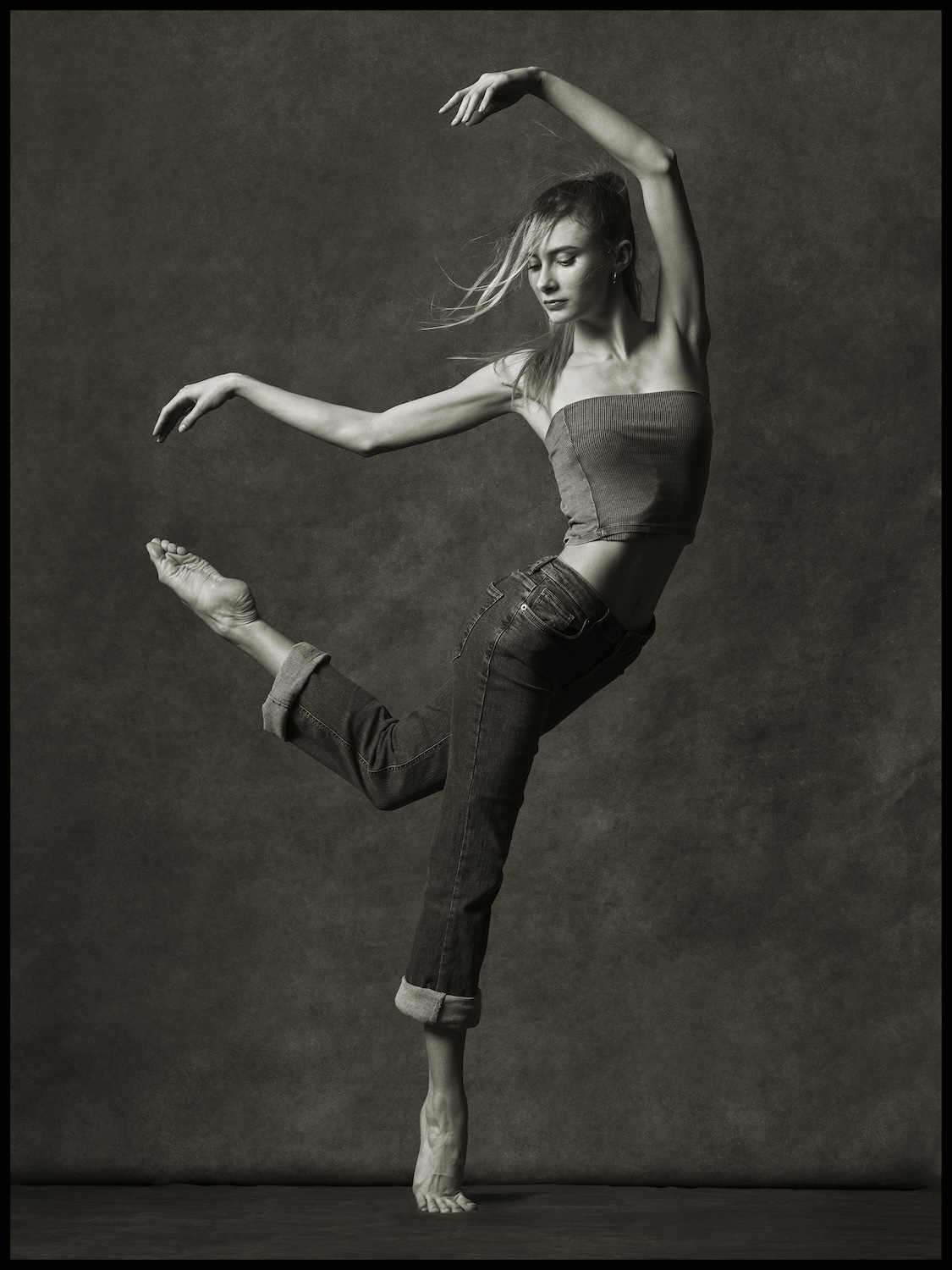
Roma Codex — Behind the Frame
Albert Watson photographie Bianca dans une posture dont la construction semble faire écho à l’iconographie de Shiva Nataraja, le « Roi de la danse ». Le bras droit levé, la jambe gauche tendue tandis que le pied d'appui demeure fermement ancré au sol, son corps paraît suspendu entre équilibre et mouvement.
Cette référence dépasse la simple citation visuelle. À l'instar de Shiva, la danseuse ne se contente pas d'occuper l'espace : elle le recrée. Chaque mouvement devient une interprétation du monde, où le corps, le geste et la personnalité donnent naissance à une réalité nouvelle. L'art ne reproduit pas le réel ; il lui donne une forme.
Sa chevelure, portée par le mouvement, évoque les mèches déployées de Shiva recevant les eaux célestes du Ganga. Elle donne l'impression que le mouvement vient d'ailleurs, comme si la danse établissait un lien entre le réel et le Ciel. La création artistique apparaît alors comme une médiation entre ces deux dimensions, où l'être humain exprime, à travers son corps, une réalité qui le dépasse.
La jambe tendue introduit toutefois une différence essentielle. Là où Shiva maintient sous son pied le démon de l'ignorance, la danseuse semble seulement prendre appui. Son corps donne l'impression d'un instant suspendu, comme si elle venait tout juste d'entrer dans ce combat. Encore en apprentissage, elle n'a pas totalement dépassé cette ignorance ; il lui reste un chemin à parcourir avant de pouvoir s'en affranchir pleinement.
Enfin, la main gauche, tournée vers la terre, peut être comprise comme un geste adressé au spectateur. La danse devient un langage partagé. Elle n'exprime pas seulement une technique, mais une manière d'habiter le monde et d'offrir une interprétation singulière du réel.
Le portrait ne représente donc pas seulement une danseuse. Il montre une artiste en devenir, dont le corps devient progressivement le lieu où se rencontrent création, transmission et dialogue entre le réel et le Ciel.
Bianca, Élève en danse classique
Coulisses
🔴 Le Devenir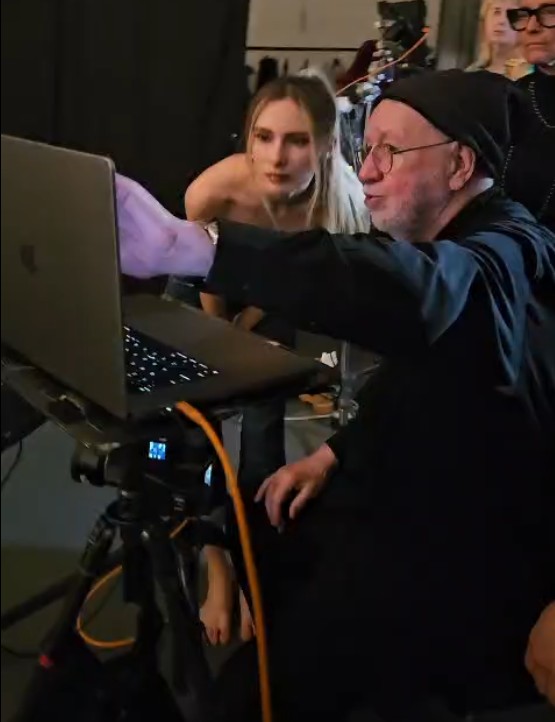
Roma Codex — Behind the Frame
Cette vidéo offre un nouvel aperçu des coulisses de Roma Codex. On y découvre Albert Watson au travail avec la danseuse Bianca, dirigeant la séance et construisant progressivement l'image. Observer son processus de création permet de mieux comprendre les choix de mise en scène, la précision des postures et l'attention portée au moindre détail, autant d'éléments qui nourrissent les analyses présentées sur cette page.
Pierfrancesco Favino
Acteur,
Restaurant Atelier Canova Tadolini
Albert Watson
🟡 Lignage / Transmission / Héritage divin 🔴 Le Devenir
Roma Codex — Behind the Frame
Albert Watson photographie Pierfrancesco Favino dans une posture d'une remarquable stabilité. Assis devant un verre de vin blanc, le corps entièrement au repos, l'acteur soutient son visage de la main droite tandis que son index repose délicatement contre ses lèvres. Sa main gauche maintient le pied du verre avec retenue, alors que sa jambe gauche vient se croiser par-dessus la droite. Rien ne semble devoir rompre cet équilibre silencieux.
La composition repose sur une organisation presque symétrique du corps. Les deux mains répondent l'une à l'autre, occupant des positions opposées mais complémentaires. Les jambes croisées prolongent cette construction géométrique, donnant au portrait une impression d'harmonie maîtrisée. Cette architecture du geste n'est pas sans évoquer certaines représentations de Shiva Nataraja, dont les membres organisent le mouvement cosmique.
Pourtant, Albert Watson en propose le contrepoint. Là où Shiva incarne une danse perpétuelle, principe de création, de destruction et de renaissance, Favino demeure parfaitement immobile. Le verre ne vacille pas, le regard reste fixe, les gestes ne produisent aucune action. La structure du mouvement est toujours présente, mais celui-ci semble avoir été suspendu. La danse devient immobilité. La destruction, qui chez Shiva prépare toujours une création nouvelle, ne débouche ici sur rien. Le mouvement est interrompu, comme si la naissance d'un monde nouveau se trouvait empêchée.
Cette immobilité est renforcée par le geste de la main droite. L'index posé contre les lèvres rappelle la figure d'Harpocrate, héritée d'Horus enfant dans la tradition gréco-égyptienne. Dans le cadre de Roma Codex, ce geste entre en résonance avec la carte The Aeon du tarot de Thoth d'Aleister Crowley, où Horus incarne l'avènement d'un nouvel âge. Pourtant, cette promesse de renouvellement semble ici suspendue. À l'instar de Shiva, le processus de transformation est interrompu. La renaissance annoncée par Horus ne se produit jamais. L'image suggère alors une forme d'usurpation symbolique : les attributs du créateur sont présents, mais la puissance créatrice demeure absente. Le silence n'apparaît plus comme le prélude à une métamorphose, mais comme le signe d'une création empêchée.
Le lieu participe lui aussi à cette construction symbolique. Le restaurant Tadolini conserve plusieurs sculptures néoclassiques d'Antonio Canova et de son élève Adamo Tadolini. À l'arrière-plan, seul le pied d'une statue apparaît, tandis que les murs rouge vénitien prolongent la profondeur de l'espace. Au premier plan, la serviette écarlate répond à cette même tonalité, alors que la nappe claire rappelle la blancheur du marbre. Les couleurs circulent d'un plan à l'autre, mais les formes s'inversent : la sculpture monumentale demeure presque invisible, réduite à un fragment, tandis que le corps vivant de Favino occupe tout le premier plan.
L'image semble ainsi se partager en deux espaces. La partie supérieure appartient à l'univers intemporel de la sculpture ; la partie inférieure demeure celle de l'homme vivant. Favino se tient précisément à cette frontière. Entre la pierre et la chair, entre le mouvement de Shiva et le silence d'Horus, entre l'œuvre et celui qui la contemple, il devient une figure d'équilibre. Mais cet équilibre n'est pas celui d'une création en devenir. Au contraire, tout semble retenu, comme si le mouvement créateur avait été interrompu avant son accomplissement. Le portrait ne montre plus seulement un acteur, mais une figure qui emprunte les signes de la création sans jamais lui permettre d'advenir. C'est peut-être dans cette suspension que réside la véritable tension de l'image.
Carlotta Gamba,
Actrice en voiture
Albert Watson
🔵 Identité / Réflexion ⚫ L’Ombre / La Dissolution
Roma Codex — Behind the Frame
L’eau qui ruisselle sur la vitre peut être rapprochée des eaux de Ganga, le fleuve céleste qui descend du Ciel vers la terre. Pourtant, Carlotta Gamba se trouve ici dans une voiture, séparée de cette eau par une double protection : la vitre et la présence d’une personne au premier plan. Cette silhouette, qui occupe une partie du champ sans se révéler pleinement, semble presque faire obstacle entre l’actrice et les eaux qui coulent devant elle.
Carlotta regarde vers le haut, attirée par quelque chose qui semble se trouver au-delà de la vitre. Son regard accompagne le mouvement de l’eau, mais son corps demeure à distance. Elle peut la voir, sans jamais pouvoir la toucher. La vitre devient alors davantage qu'une simple séparation physique : elle constitue un véritable rempart, maintenant l'actrice dans un espace clos et empêchant le contact avec ce qui pourrait venir du Ciel.
La présence au premier plan renforce cette impression. Elle semble veiller à ce que cette rencontre ne puisse avoir lieu, comme si une force extérieure maintenait Carlotta à distance de cette eau. L'actrice se trouve ainsi entre deux mondes : enfermée dans l'habitacle, elle contemple une réalité extérieure qui paraît pourtant lui être destinée.
Cette position donne une autre portée au mouvement de l'eau. Dans le récit de Ganga, l'eau céleste doit pouvoir atteindre la terre pour la purifier. Ici, le processus semble interrompu. L'eau est là, visible, mais son passage est empêché. Carlotta peut seulement la contempler à travers une surface qui transforme déjà son image.
La photographie devient alors celle d'une possibilité empêchée. Quelque chose vient du Ciel, quelque chose pourrait être reçu, mais un intermédiaire s'interpose. L'actrice demeure dans cet entre-deux, fascinée par ce qui se trouve au-delà de la vitre, sans pouvoir entrer en contact avec lui. La voiture devient ainsi une sorte d'espace de confinement, tandis que l'eau, tout autour d'elle, semble porter la promesse d'un passage qui ne peut pas encore s'accomplir.
Nymphes découvrant la tête d'Orphée, 1900
John William Waterhouse
⚫ L’Ombre / La DissolutionRoma Codex — Points of Entry
Le mythe d'Orphée
John William Waterhouse représente un instant situé après la mort du poète. Deux nymphes sont assises au bord d’un cours d’eau, dans une forêt dense et sombre. À gauche, vêtue d’une longue robe bleue, l’une des jeunes femmes se penche vers l’eau ; à droite, une seconde nymphe, vêtue de rose et de mauve, tient une jarre dorée contre elle. Toutes deux dirigent leur attention vers la surface du bassin, où apparaît, au bas de la composition, la tête d’Orphée.
Orphée est un musicien et un poète dont le chant possède un pouvoir extraordinaire. Sa musique peut émouvoir les hommes, apaiser les animaux et même toucher les puissances du monde souterrain. Il épouse Eurydice, mais celle-ci meurt peu après, mordue par un serpent alors qu'elle cherche à échapper à un homme qui la poursuit. Inconsolable, Orphée refuse sa disparition. Il descend aux Enfers pour la retrouver. Sa musique parvient à émouvoir Hadès et Perséphone, qui acceptent de lui rendre Eurydice à une condition : il devra marcher devant elle sans jamais se retourner pour la regarder avant d'avoir quitté le royaume des morts.
Orphée remonte alors vers la lumière, Eurydice le suivant. Mais juste avant d'atteindre le monde des vivants, pris par le doute, il se retourne. Eurydice disparaît immédiatement, cette fois pour toujours. Orphée perd alors définitivement celle qu'il était venu chercher. La tentative de suicide échoue. Il revient à la vie, il demeure inconsolable et continue de chanter son chagrin. Son existence semble désormais entièrement absorbée par Eurydice. Son destin le conduit finalement vers les Ménades, les femmes du cortège de Dionysos. Dans leur univers dionysiaque, les frontières entre l'individu, le groupe, l'humain et l'animal deviennent poreuses. Les Ménades finissent par mettre Orphée à mort et par démembrer son corps. Sa tête et sa lyre sont ensuite jetées dans le fleuve, mais sa tête continue de chanter avant d'être recueillie.
Orphée et la nigredo
Cette trajectoire peut alors être rapprochée du processus de la nigredo. Orphée entre dans une phase de dissolution après la seconde perte d'Eurydice. Sa faute, dans cette lecture, n'est pas d'avoir aimé Eurydice, mais d'avoir fini par faire d'elle le sens de sa vie. Lorsqu'il la perd définitivement, il ne parvient plus à se définir en dehors d'elle.
La fête dionysiaque devient alors le lieu symbolique de cette dissolution. L'individu s'y défait de ses limites et se fond dans une expérience collective où les identités se brouillent. Pour Orphée, cette dissolution intérieure trouve finalement son équivalent physique dans le démembrement de son corps. Ce qui s'était déjà défait en lui est désormais détruit dans la matière. Orphée perd ainsi progressivement une partie de lui-même, jusqu'à ce qui faisait de lui un artiste. Il demeure musicien, mais son art n'est plus porté par une existence qui lui donne un sens. Son erreur est peut-être d'avoir oublié que son don musical constituait lui aussi une vocation, indépendante de son rôle d'époux d'Eurydice.
Waterhouse ne peint pas le moment de la mort, mais le moment où quelque chose reste après elle. Son chant a changé de nature ; il est devenu le ruissellement de l'eau. Les deux nymphes paraissent troublées par cette présence qu'elles ne peuvent saisir. Elles se penchent vers le ruissellement comme si quelque chose les appelait depuis la surface. Orphée devient presque un être de la nature, à l'image des nymphes elles-mêmes.
Son chant aurait ainsi changé de forme. Il ne se fait plus entendre comme une musique, mais comme le mouvement de l’eau. Orphée semble avoir quitté le monde humain pour rejoindre celui qu’il avait toujours su charmer.
David Bowie
Albert Watson
⚫ L’Ombre / La Dissolution
Roma Codex — Points of Entry
Albert Watson représente ici la tête de David Bowie enfermée dans une cage de bois, fermée par une grille métallique. Cette mise en scène évoque immédiatement l'univers du supplice, de l'enfermement et de la mort symbolique. La tête, séparée du corps, semble privée de toute possibilité d'action. Les yeux clos renforcent cette impression d'intériorité silencieuse, tandis que la cage rappelle autant un reliquaire qu'un chenil, réduisant l'homme à une condition presque animale.
Cette image peut être rapprochée de la nigredo, première étape de l'alchimie spirituelle, où l'individu traverse un processus de dissolution de l'ego. Cette phase est traditionnellement présentée comme une étape nécessaire avant une renaissance. Pourtant, rien, ici, ne laisse entrevoir une quelconque transfiguration. La décomposition paraît avoir atteint son terme sans ouvrir sur une nouvelle naissance.
La cage devient alors le symbole d'un enfermement définitif. L'homme, privé de sa dimension spirituelle, demeure prisonnier de la matière. La promesse initiatique s'effondre : la destruction de l'ego ne conduit pas à une conscience supérieure, mais à une existence réduite à ses seuls instincts. L'être humain devient un animal humain, enfermé dans une condition dont il ne peut plus s'extraire.
Cette lecture trouve un écho particulier dans le parcours de David Bowie. Au cours des années 1970, son œuvre s'est nourrie de nombreuses références à l'ésotérisme, à l'occultisme et aux traditions initiatiques. La photographie semble prolonger cette réflexion en montrant non pas l'accomplissement d'une quête spirituelle, mais son renversement. Là où l'initiation promet une élévation, il ne subsiste qu'une tête enfermée, privée de tout lien avec le Ciel.
À l'inverse de la tête d'Orphée peinte par John William Waterhouse, dont le chant continue de traverser le temps après la mort du poète, celle de David Bowie demeure silencieuse. Le travail, Le chant, l'art n'est plus présenté comme une force capable d'ouvrir un passage vers le spirituel. Il devient le témoignage d'une condition humaine enfermée dans ses propres limites.
Olimpia Pagni
Club, Muccassassina
Albert Watson
⚫ L’Ombre / La Dissolution
Roma Codex — Behind the Frame
Albert Watson photographie ici la chanteuse Olimpia Pagni lors de la Muccassassina, célèbre soirée romaine où les identités, les apparences et les codes sociaux sont volontairement brouillés. Dans cette atmosphère nocturne, son cou disparaît presque entièrement dans l'obscurité, donnant l'impression que sa tête se détache progressivement du corps. Les yeux presque fermés renforcent cette sensation de suspension, comme si elle se trouvait déjà à la frontière entre deux mondes.
Cette mise en scène peut être rapprochée du mythe d'Orphée. Comme le poète thrace, l'essence du métier d'Olimpia Pagni semble subsister à travers sa tête. L'image suggère cette idée en dissipant son cou dans cette masse noire.
Le choix de la Muccassassina renforce directement cette référence. Après la perte définitive d'Eurydice, Orphée demeure inconsolable et cherche à noyer son chagrin dans une existence tournée vers la débauche et les fêtes dionysiaques. Les Ménades, qui appartiennent au cortège de Dionysos, finiront par le mettre à mort et par démembrer son corps. La fête devient ainsi le prélude symbolique à sa destruction.
La Muccassassina apparaît alors comme le théâtre d'une métamorphose inachevée. La séparation de la tête et du corps ne révèle pas un accomplissement spirituel, mais une rupture. Loin de conduire vers une conscience supérieure, elle prive l'être humain de sa vocation spirituelle et le ramène à une existence gouvernée par l'instinct, celle d'un animal humain.
La photographie prolonge ainsi la réflexion engagée avec le mythe d'Orphée. L'art demeure, mais il ne permet pas de transcender la condition humaine. Ce qui subsiste n'est pas une victoire sur la mort, mais le témoignage fragile de ce qui faisait la singularité de l'être.
David Bowie
Albert Watson
⚫ L’Ombre / La Dissolution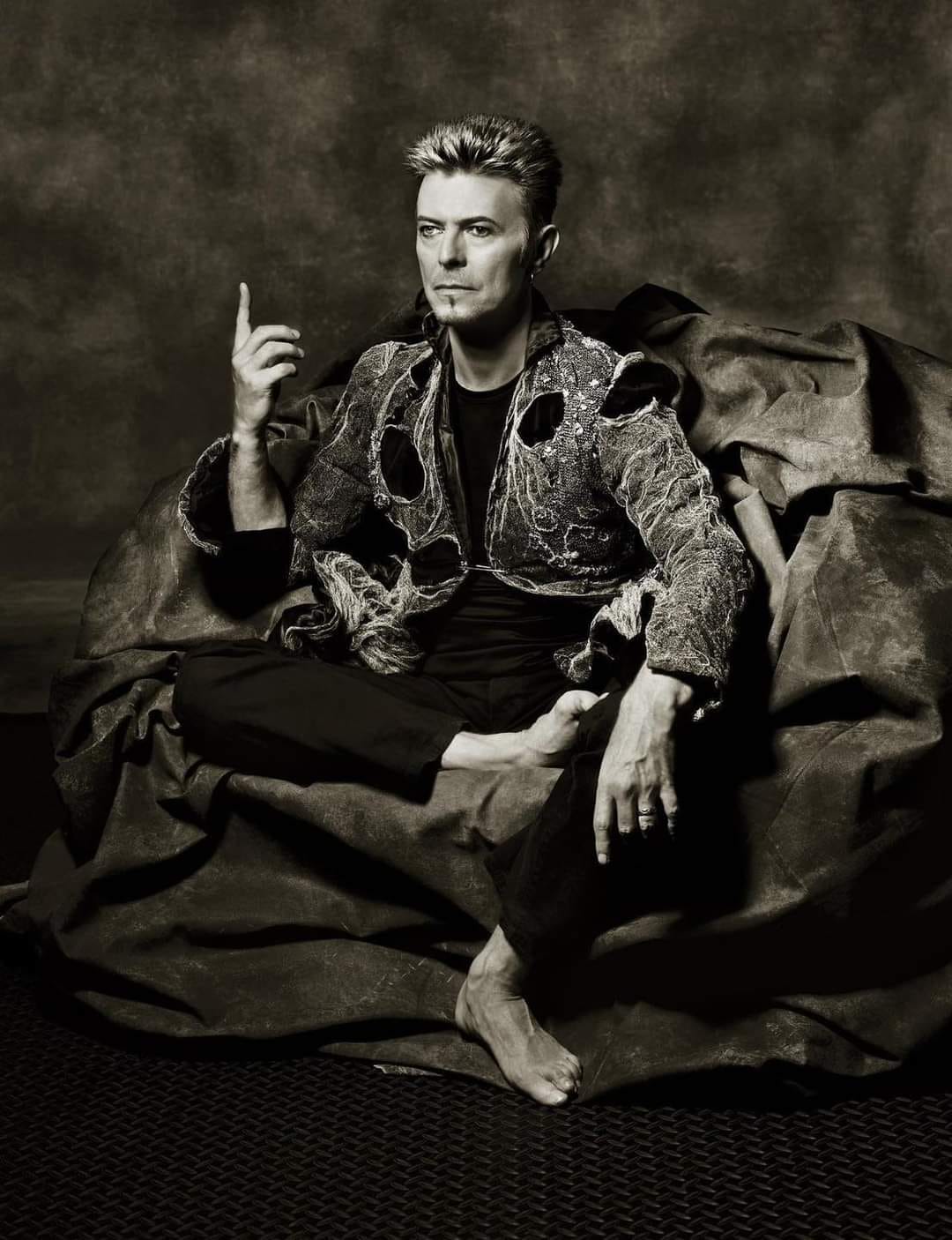
Roma Codex — Clefs de lecture
Une main pointée vers le ciel, l’autre vers le sol : une iconographie duale qui rappelle Baphomet et le principe « ce qui est en haut est comme ce qui est en bas ». Une construction qui fait écho à l’intérêt de Bowie pour les systèmes ésotériques associés à Aleister Crowley.
Museum et Crypte des Capucins,
Frères, Ossements, Squelettes
Albert Watson
⚫ L’Ombre / La Dissolution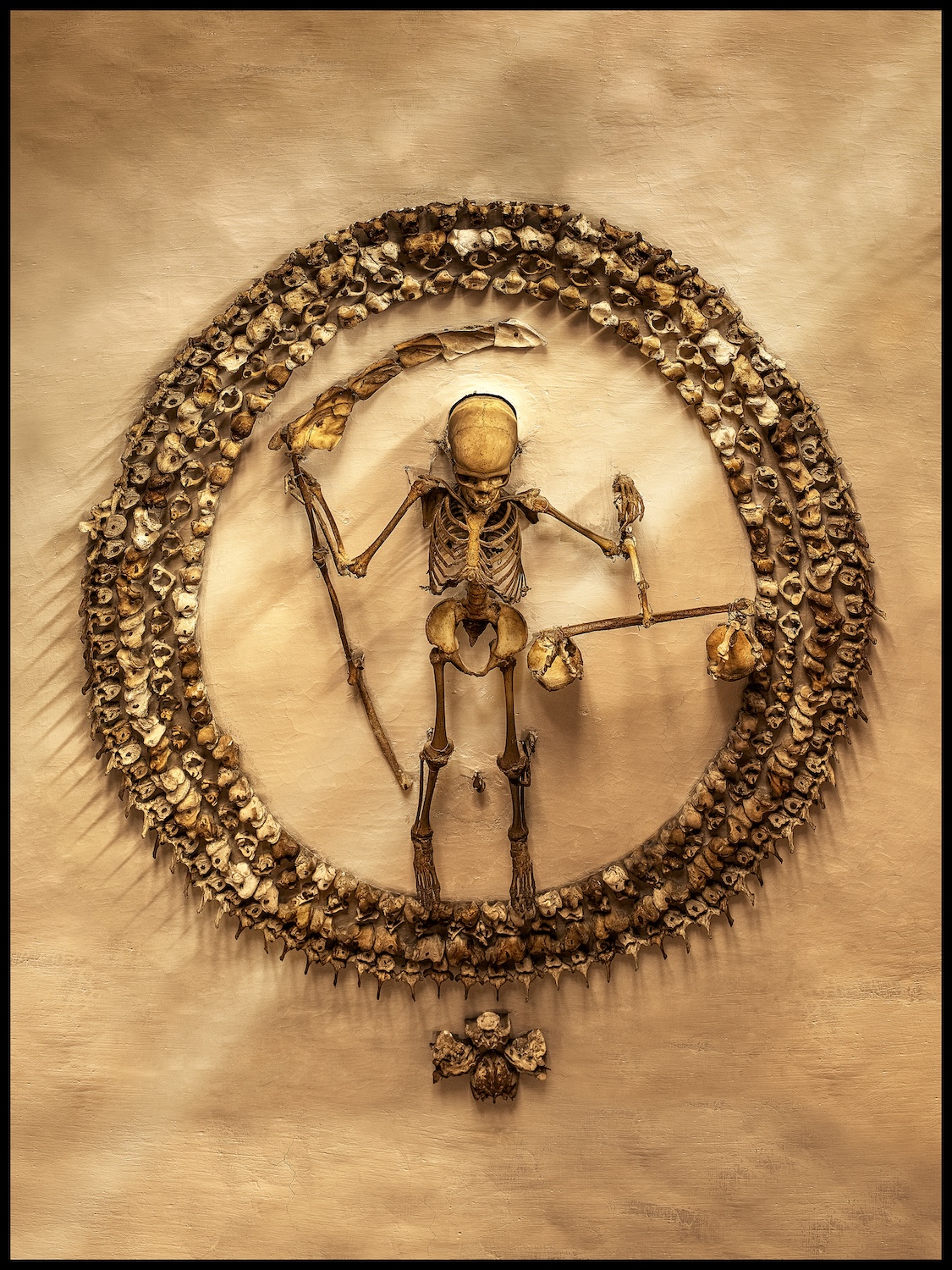
Roma Codex — Behind the Frame
Dans la crypte des Frères Capucins, Albert Watson capture un squelette suspendu au plafond de l’une des salles, intégré à une composition d’ossements conçue comme un dispositif visuel.
En 1631, à la suite de la construction de l’église, le cardinal Antonio Marcello Barberini ordonna le transfert des dépouilles des frères capucins ainsi que leur arrangement « artistique ».
Ce geste s’inscrit dans le contexte de l’Inquisition — une institution de l’Église chargée de préserver l’orthodoxie religieuse en identifiant et en jugeant les écarts doctrinaux. Les restes des moines deviennent ainsi des motifs, une structure, presque un langage — une mise en scène qui sacralise la disparition.
La figure centrale, tenant une balance et une faux, réunit une iconographie composite. Les deux figures symboliques auxquelles ces attributs se réfèrent traditionnellement sont ici remplacées par une figure humaine, incarnée par le squelette du moine. La balance rappelle les attributs du jugement associés à saint Michel Archange, tandis que la faux évoque Samaël, figure de l’ange de la mort, incarnation même du chaos, de la punition, de la colère, de la mort et du désordre.
Le jugement et la mort ne sont plus portés par une figure céleste, mais par un corps humain réduit à l’état de squelette — comme si l’Église, à travers l’homme, avait pris la place du jugement divin et de la mortalité. Cette mise en scène macabre devient une ode à la mort.
Par la lumière et le fond doré, Albert Watson replace ces figures dans un espace céleste, faisant écho aux codes de l’iconographie religieuse. Les rayons lumineux évoquent l’illumination divine traversant les vitraux, renforçant cette dimension spirituelle — tout en révélant son caractère construit.
Comme l’indique l’inscription présente dans la crypte, également visible dans la Trinité de Masaccio (1425–1428),
où elle apparaît au-dessus du tombeau d’Adam sous la forme d’une inscription à la première personne :
« Io fui quel che voi siete e quel ch’io sono voi anco sarete »
(« J’étais ce que vous êtes, et ce que je suis, vous le serez aussi. »)
Régiment de Cuirassiers,
Palais du Quirinal,
Chevaux, Uniformes
Albert Watson
⚫ L’Ombre / La Dissolution
Roma Codex — Behind the Frame
Albert Watson photographie une succession de cuirassiers avançant à cheval. La répétition des silhouettes produit un effet proche de la chronophotographie : chaque cavalier semble se substituer au précédent, comme si une même figure se répétait à travers le temps.
Les uniformes, les casques et les montures construisent une image où les singularités deviennent presque imperceptibles. Ce qui demeure n'est plus la personne, mais la permanence de la fonction.
Cette construction prolonge la lecture de la nigredo. Traditionnellement, la dissolution de l'ego prépare une renaissance spirituelle. Ici, cette renaissance n'advient jamais. L'effacement de l'individu devient la condition même de l'institution.
Chaque cavalier succède au précédent sans modifier l'ordre établi. La continuité repose sur cette transmission où les hommes passent tandis que la fonction demeure. L'image évoque une chaîne ininterrompue dans laquelle chacun occupe provisoirement une place appelée à être reprise par un autre.
Cette lecture entre en tension avec les traditions initiatiques. Là où la nigredo annonce une transformation intérieure et l'accès à une conscience renouvelée, Albert Watson semble en montrer le revers. La dissolution de l'ego ne conduit pas à une renaissance spirituelle, mais à une forme de dépossession. Les cavaliers ne deviennent pas des êtres plus libres ou plus conscients ; ils s'effacent derrière la fonction qu'ils incarnent, réduits à assurer la continuité d'un ordre qui les dépasse.
Régiment de Cuirassiers,
Palais du Quirinal,
Cheval
Albert Watson
⚫ L’Ombre / La Dissolution
Roma Codex — Behind the Frame
Albert Watson photographie un cuirassier du Reggimento Corazzieri au moment où il lève son sabre et lance un ordre. Le casque recouvre presque entièrement son regard, comme si son identité s'effaçait derrière la fonction qu'il incarne.
Cette dissimulation peut être rapprochée de la nigredo, première étape de l'alchimie spirituelle. Dans les traditions initiatiques, cette « œuvre au noir » marque la dissolution de l'ego avant une renaissance intérieure. L'obscurité n'est pas une fin, mais le commencement d'une transformation.
La photographie semble pourtant suspendre ce processus. Le regard demeure dissimulé, absorbé par le casque, tandis que la voix du cavalier se confond avec celle de l'institution qu'il représente. Rien ne laisse entrevoir une élévation spirituelle. La dissolution de l'ego n'ouvre pas ici sur une conscience nouvelle : elle conduit à l'effacement progressif de l'individu derrière son rôle.
Le portrait interroge ainsi la frontière entre engagement et dépossession. À quel moment le service d'une fonction cesse-t-il d'exprimer une volonté personnelle pour absorber celui qui l'exerce ? Là où l'alchimie promet une renaissance, Albert Watson semble montrer une transformation inachevée, où l'homme demeure prisonnier de la fonction qu'il incarne.
Place Saint Pierre,
Sapin de Noël, Mouettes, Oiseaux
Albert Watson
🟡 Lignage / Transmission / Héritage divin 🔴 Le Devenir ⚫ L’Ombre / La Dissolution
Roma Codex — Behind the Frame
Au premier plan, plusieurs mouettes occupent l’espace de la place, immobiles ou en mouvement, comme si elles en étaient devenues les habitantes provisoires. Derrière elles se déploie l’architecture du Vatican, monument chargé d’histoire et de symboles, tandis qu’un immense sapin de Noël s’élève devant la façade, entouré de barrières de sécurité qui délimitent l’espace réservé aux visiteurs.
Ce sapin évoque inévitablement celui du Rockefeller Center à New York. Pourtant, l’image ne semble pas proposer une simple critique de l’influence américaine. Elle interroge plutôt une question plus profonde : celle du déplacement et du remplacement des symboles.
Dans Roma Codex, Albert Watson explore souvent les notions de transmission, d’héritage et de continuité. Ici, un élément issu d’une culture contemporaine mondialisée vient s’inscrire au cœur d’une ville dont l’identité s’est construite sur des siècles d’histoire. Le contraste ne réside pas seulement dans l’opposition entre Rome et l’Amérique, mais dans la manière dont les symboles circulent, se transforment et prennent possession de nouveaux territoires.
Les mouettes deviennent alors un élément essentiel de la lecture de l’image. Elles occupent une place momentanément désertée par les hommes. Leur présence donne l’impression que l’espace urbain, habituellement contrôlé et organisé, leur appartient désormais. Cette situation rappelle Venise, où certains hôtels et monuments font appel à des fauconniers afin d’éloigner les mouettes devenues trop nombreuses dans la ville. Le faucon n’est pas seulement un moyen de régulation : il porte une dimension symbolique, celle d’un gardien chargé de préserver un équilibre.
Cette évocation fait écho à la figure d’Horus, le dieu faucon de l’Égypte ancienne, protecteur du pharaon et garant de l’ordre du monde. Là où Horus veille sur l’harmonie du royaume, les mouettes apparaissent ici comme les occupantes provisoires d’un espace dont les anciens gardiens semblent absents. L’absence du faucon devient alors aussi signifiante que la présence des oiseaux. Aucun élément ne semble venir rétablir l’ordre habituel. Entre le sapin monumental, symbole d’un imaginaire international, le Vatican, mémoire d’une histoire ancienne, et cette nature qui reprend momentanément possession de l’espace, Rome apparaît comme une ville en transition.
Albert Watson semble mettre en scène un déplacement silencieux des symboles : certains disparaissent, d’autres apparaissent, et la ville devient le lieu où ces différentes strates du temps coexistent, parfois harmonieusement, parfois dans une tension fragile