
Young girl before the mirror, 1923
Pablo Picasso
🔵 Identity / ReflectionRoma Codex - Points of entry
Facing the mirror, the woman confronts her own appearance, gaining a form of self-awareness through her reflection.
Yet the image returned is altered: the gaze darkens, the colours become denser, almost opaque. Rather than faithfully reproducing reality, the reflection introduces a shift, as though another dimension of the self were emerging.
In this perspective, the image can be related to gnosis—from the Greek gnôsis, meaning “knowledge”—understood as an inner, spiritual form of knowing that is not attained through the mere observation of the visible world, but through a journey toward a deeper understanding of oneself.
The mirror also constitutes a true initiatory device in many esoteric traditions. In catoptromancy, the aim is not to contemplate one's own reflection, but to look beyond the surface in order to perceive images or symbols. In ceremonial magic, the black mirror, which absorbs light rather than reflecting it, is used as a medium for meditation, protection, and the emergence of inner visions.
This logic also finds an echo in Freemasonry, where the mirror occupies a central place in the Chamber of Reflection. Left alone before their own reflection, the initiate is invited to move beyond the image they hold of themselves and begin a process of inner transformation.
In this reading, Picasso's reflection does not reveal a stable identity but instead unsettles the perception of the self. Knowledge no longer resides in what is immediately seen, but in what emerges when the gaze itself is displaced.
The Delphic maxim, "Know thyself," therefore acquires a particular resonance. It is not merely an invitation to introspection, but to explore a more essential dimension of being, where self-knowledge is understood not as a fixed state, but as an ongoing path.
Gaetano Aloisio,
Master Tailor,
Via di Porta Pinciana,
Mirrors
Albert Watson
🔵 Identity / Reflection
Roma Codex — Behind the Frame
Albert Watson captures the portrait of Gaetano Aloisio in his atelier. The mirrors surrounding him multiply his presence and open several layers of interpretation.
At first glance, the reflection seems to evoke a tradition in which the mirror becomes an instrument of self-knowledge. The face appearing in the mirror seems darker, the gaze more intense. The hand placed in his pocket contrasts with the visible hand in the atelier, the one associated with gesture and craftsmanship. This tension recalls certain representations in which the mirror becomes a path toward inner knowledge.
In initiatory traditions, it is conceived as a device of self-confrontation, particularly through gnosis — from the Greek gnôsis, “knowledge” — understood as a deeper inner and spiritual form of understanding. Within the Masonic tradition, however, this quest does not lead to the possession of a definitive truth. Absolute Truth is considered inaccessible to the human mind; it remains an ideal toward which the initiate moves. Knowledge is built through questioning, dialogue, and continuous reconsideration. The mirror therefore does not reveal a final answer: it places the individual within an ongoing search.
Yet Albert Watson appears to shift this logic.
The multiplication of mirrors fragments the image of the tailor. No single reflection reveals a complete identity; each one offers only a fragment, an angle, a partial presence. This multiplicity of viewpoints recalls one of the fundamental principles of Cubism, where reality is no longer perceived from a single perspective, but through the coexistence of several viewpoints within the same image. As in Cubist compositions, the subject appears simultaneously through different aspects, escaping any unified and definitive representation. Here, however, fragmentation does not lead to complete knowledge. The reflections never converge to reconstruct a whole. Instead, they remind us that every perception remains partial and that identity cannot be contained within a single image.
The mirror therefore ceases to function as a device of absolute revelation; it becomes a space of inquiry, a constant displacement of the gaze.
The photograph proposes another path. What defines Gaetano Aloisio is his craft. His identity is revealed through work, the precision of gesture, and the mastery of his eye. He embodies the living memory of a savoir-faire enriched over centuries, an inheritance transmitted, transformed, and extended through his own practice. Through him, it is not only a man that appears, but the continuity of an artisanal tradition. Where the mirror multiplies perspectives, the work establishes a presence.
Massimiliano Fuksas,
Architect, Studio Fuksas
Albert Watson
⚫ THE SHADOW / THE DISSOLUTION
Roma Codex — Behind the Frame
Albert Watson photographs Massimiliano Fuksas in a posture of quiet authority. Standing behind the architectural model with both hands resting firmly upon it, he dominates the composition with an almost intimidating presence. Yet it is not the architecture that first commands the viewer's attention, but his face.
Light carves across his features with an almost unreal precision. Isolated from the darkness that envelops the rest of his body, his face resembles a mask suspended in the shadows. His faint smile takes on the appearance of an enigmatic grin, reinforcing the impression of a spectral presence. The silhouette itself seems to dissolve, leaving only a head that hovers above the model, as though detached from the body that supports it.
This dissociation becomes even more striking when compared with Albert Watson's portrait of Doriana Fuksas. In that photograph, her face was partially concealed by the architectural model, as though the architect and her work had become one. Here, the movement is reversed. The face asserts itself so strongly that the model almost disappears, yet the two never seem to establish a true relationship. They occupy the same space while appearing to belong to different worlds.
This separation evokes a more symbolic image: that of a head detached from its support, surviving beyond what once gave it form. It recalls the myth of Orpheus, whose severed head continued to sing after being separated from his body. The photograph seems to echo one of the myth's central ideas: the survival of presence after rupture.
The architectural model no longer appears as the natural extension of its creator. Instead, it becomes an autonomous object, while the face acquires an existence of its own, almost independent of it. A distance emerges between the work and the one who conceived it. The creation remains, while its creator seems already to belong to another realm, like a shadow that continues to hover above what he has left behind.
Doriana Mandrelli
Architect, Studio Fuksas
Albert Watson
🔵 Identity / Reflection 🔴 THE ACT OF BECOMING
Roma Codex — Behind the Frame
Albert Watson photographs Doriana Mandrelli in a composition where portrait and architecture appear to merge into a single image. Only half of her face is revealed; the other half disappears behind the architectural model, which occupies precisely the space of what remains unseen. Far from being a simple compositional device, this superimposition establishes a visual continuity between the subject and the structure she helped conceive.
The boundary between the architect and her work gradually dissolves. The model is no longer merely an object placed before its creator; it becomes an extension of her presence. As though architecture had absorbed part of her identity, Doriana seems to inhabit the forms she has helped shape. Her gaze remains visible, but her face exists only through this coexistence with the architectural form.
This reading is reinforced by a subtle yet significant detail. Albert Watson identifies her as Doriana Mandrelli, her maiden name, rather than Doriana Fuksas, the name by which she is widely known professionally. This editorial choice invites the viewer to perceive her as an individual in her own right, rather than solely through her association with Massimiliano Fuksas. The photograph presents not only a partner within Studio Fuksas, but an autonomous creative figure whose vision is inseparable from the architecture itself.
The portrait takes on an even richer meaning when viewed alongside Albert Watson's photograph of Massimiliano Fuksas. In Doriana's portrait, the face merges with the architectural model until the two become almost inseparable. In Massimiliano's, by contrast, the illuminated face detaches itself from the model, asserting an independent presence that seems to hover above it. Together, the two portraits suggest complementary relationships between creator and creation: one in which the architect becomes embodied in the work, and another in which the creator appears to stand apart from it, as though the face alone survived beyond the act of creation.
Portrait
Patrick et Victor Demarchelier
🟡 LINEAGE / TRANSMISSION / DIVINE HERITAGE 🔵 Identity / Reflection 🔴 THE ACT OF BECOMINGRoma Codex - Points of entry
Patrick Demarchelier and his son Victor create here a self-portrait in two voices. Seated on a simple chair, Patrick adopts a pose originally conceived by Victor. Beside him, Victor chooses a different attitude. Perched on the backrest rather than the seat, his arms crossed, he occupies a temporary position, as though he were still searching for his place within the image. The two men share the same space without ever adopting the same posture. Each asserts his own presence.
This asymmetry goes beyond a simple difference of generations. Patrick appears firmly grounded, while Victor remains in a state of exploration. His unstable position suggests not uncertainty, but a process of becoming. The point is not yet to take his father's place, but to discover his own. The photograph therefore does not portray succession; it captures a moment of transition.
The setting reinforces this idea. The studio remains deliberately visible: a black backdrop frames the scene, while one of its support wheels appears at the edge of the image. Nothing is concealed. The photograph openly acknowledges its own making, as if Patrick and Victor were inviting the viewer to witness not only the finished portrait, but also the process behind it.
This staging reveals a demanding vision of inheritance. Patrick does not hand down a predefined place; he encourages his son to create his own. Inheritance is not about reproducing another's path, but about building one's own from what has been received. Victor is not expected to become another Patrick Demarchelier. He is invited to become fully himself.
Statue of the God Horus Protecting Ramesses II
Royal Necropolis of Tanis
🟡 LINEAGE / TRANSMISSION / DIVINE HERITAGERoma Codex — Points of Entry
This sculpture depicts the young Ramses II seated before an immense falcon with outstretched wings. Still a child, the future pharaoh is recognizable by the sidelock of childhood and the gesture of his finger held to his mouth. Behind him, the god rises as a monumental and protective presence, his body and wings almost entirely enveloping the young sovereign. The composition rests on a striking contrast between the small human figure and the imposing power of the god. Ramses appears calm and self-possessed, while the falcon forms a vertical, protective, and sovereign presence behind him. The god becomes at once guardian, protector, and embodiment of divine authority.
In the Egyptian tradition, the falcon is closely associated with Horus, god of the sky and kingship. Horus embodies sovereignty, protection, and the maintenance of cosmic order. The living pharaoh himself is traditionally associated with Horus: the earthly sovereign thus becomes the manifestation of divine authority. The sculpture translates this relationship directly into its form. The god stands literally behind the king, transforming invisible divine protection into a tangible presence. His wings form a monumental shield around the young Ramses. Protection is therefore not merely suggested: it becomes the very architecture of the sculpture.
Horus is also associated with the Eye of Horus, a symbol of protection, restoration, and wholeness. In the myth, the eye is lost during the conflict with Seth before being restored. This idea of restoration echoes a fundamental principle of Egyptian thought: the return to order after chaos. The relationship between the falcon and the young king is therefore far more than a simple decorative association. The divine figure gives meaning and legitimacy to the human figure. Ramses is protected by Horus, but he is also inscribed within the divine order that defines his future role as pharaoh.
Emanuele Filiberto of Savoy,
Prince of Venice,
Pantheon, flower, bouquet, tomb
Albert Watson
🟡 LINEAGE / TRANSMISSION / DIVINE HERITAGE
Roma Codex — Behind the Frame
At the heart of Rome’s Pantheon, Albert Watson photographs Emanuele Filiberto of Savoy in front of the tomb of Victor Emmanuel II of Italy, a central figure of the Risorgimento and the first king of a unified Italy in the nineteenth century. As heir to the House of Savoy and pretender to the throne, the Prince stands before this foundational memory. His name confers upon him a certain stature — an inscription in History.
Framed by two columns, his body is inscribed within an architecture that surpasses him. The tomb in the background functions as a visual device: a materialization of inheritance, prestige, and dynastic continuity. Above him, the monumental eagle extends this symbolic architecture. Yet, unlike the organic bond that traditionally unites the sovereign with his emblems, the bird remains here separate from the figure of the Prince.
In Albert Watson’s photograph, the relationship is reversed. The eagle remains monumental, but it is now detached from the Prince’s body. It belongs to the setting, to the tomb, to the history of a vanished monarchy. It no longer protects the figure, envelops him, or guarantees his accession to power. The symbol remains, but the power it once represented has withdrawn.
It is precisely within this distance that the tension of the image unfolds.
For Emanuele Filiberto, the eagle survives as the trace of a power that is no longer operative. Where Horus accompanies the future sovereign toward his destiny, the eagle of the Pantheon refers instead to a power already fulfilled, and subsequently vanished. The monumentality of the tomb points to the remnants of power: a political and symbolic structure belonging to a bygone order, still legible through its signs, made visible by a name, but now reduced to a memory — an inscription detached from its context. A name that has become a trace. Filial descent thus appears as a suspended form: tied to a vanished past, yet still active within the field of the image. The Prince seems almost absorbed by what he embodies, positioned between the signs of an inherited grandeur and the contemporary impossibility of giving it an equivalent political function.
The image thus opens up a tension between two forms of inheritance. In Egyptian sculpture, divine filiation leads the young king toward a power yet to come. In contemporary photography, dynastic filiation points, by contrast, toward a power that is no longer to come, but already belongs to the past. Between inheritance and emancipation, the image therefore questions the possibility of inhabiting a name when that name refers to a symbolic structure that has become inoperative, yet whose signs remain visible everywhere.
The eagle of the Pantheon has become its vestige.
Claudio Del Falco,
Actor, Parrot, Bird,
Sporting Village Gyms
Albert Watson
🟡 LINEAGE / TRANSMISSION / DIVINE HERITAGE 🔵 Identity / Reflection 🔴 The Act of Becoming
Roma Codex — Behind the Frame
Albert Watson photographs actor Claudio Del Falco in a portrait that appears to weave together several references to Egyptian mythology.
The crossed arms immediately recall the iconography of Osiris, ruler of the underworld. According to the myth, Osiris is murdered by his brother Seth, who usurps the throne of Egypt. Isis then reassembles her husband's body and miraculously conceives their son, Horus, after his death. As a posthumous heir, Horus grows up before confronting Seth in a long struggle to reclaim his father's kingdom. After years of conflict, the divine tribunal finally recognizes the legitimacy of his lineage and grants him the throne.
This judgment establishes one of the founding principles of Egyptian kingship: royal authority is transmitted from father to son. From that moment on, every living pharaoh is regarded as the earthly incarnation of Horus, while the deceased ruler becomes a new Osiris.
Within this reading, the bird perched on Claudio Del Falco's shoulder can be understood as a symbolic evocation of Horus. Rather than reproducing the traditional image of the falcon-headed god, it becomes the sign of a lineage accompanying the Osirian pose adopted by the actor. This symbolism resonates with Claudio Del Falco's own family history. A descendant of the Iovinelli theatrical dynasty, founded by Giuseppe Jovinelli (born Iovinella), he inscribes himself within an artistic genealogy. By adopting the posture of Osiris, he does more than pay tribute to his ancestor: he asserts his place as the legitimate heir and guardian of a theatrical tradition handed down across generations. The portrait therefore moves beyond the representation of an individual. It stages the continuity of a lineage, in which each generation receives an inheritance before passing it on to the next. This logic recalls an inscription often found in crypts:
"I was what you are; you will become what I am."
Like the cycle of Osiris and Horus, lineage is not merely about the past. It places each heir within a chain of transmission, where an inheritance exists only through those who choose to embody it.
The Aeon (Trump XX),
illustration from the Thoth Tarot
(The Book of Thoth), 1944
Illustrated by Lady Frieda Harris and conceived by Aleister Crowley
🟡 LINEAGE / TRANSMISSION / DIVINE HERITAGE 🔴 The Act of BecomingRoma Codex — Points of Entry
In the Thoth Tarot, Aleister Crowley replaces the traditional Judgement card with The Aeon. This is far more than a change of title: it reflects an entirely new understanding of spiritual evolution. The Christian Last Judgement gives way to the Aeon of Horus, an era in which every individual is called to discover their True Will.
At the centre of the card stands Horus, the son of Isis and Osiris, whom Crowley describes as the Crowned and Conquering Child. Rather than symbolising sacrifice or redemption, Horus embodies the emergence of a sovereign consciousness, liberated from inherited dogmas and external authority.
The card therefore no longer depicts a judgement pronounced by a divine power. Instead, it represents an inner transformation, inviting each individual to follow their own path and fulfil their unique destiny.
From this perspective, The Aeon can be understood as the culmination of the initiatory process. After the nigredo—the first stage of spiritual alchemy, in which the ego is dissolved— comes the possibility of rebirth. The disappearance of the former self is not an end in itself, but the necessary condition for the emergence of a renewed consciousness.
The Aeon therefore does not announce the end of the world, but the beginning of a new one: an age in which the individual is called to become fully themselves.
Poster depicting Donald Trump and the Strait of Hormuz, Valiasr Square, Tehran, May 2, 2026
Illustrated by Lady Frieda Harris and conceived by Aleister Crowley
🟡 LINEAGE / TRANSMISSION / DIVINE HERITAGE
Roma Codex — Points of Entry
The image can therefore be read as a political and symbolic message addressed beyond Iran's borders. The extremely tight framing shows only part of Trump's face: only the nose and lower part of the face are visible, while a broad blue ribbon is placed just above the upper lip. This ribbon visually represents the Strait of Hormuz, transforming the mouth of the American president into a geopolitical space. The mouth, as the site of speech and authority, is thus placed under the sign of a strategic territory. Above it, the inscription “At The Breaking Point,” accompanied by its Persian translation, reinforces the idea of a power that has reached the point of rupture.
The gesture of the finger held to the lips introduces a direct reference to Harpocrates, the Greco-Egyptian form of the child Horus, traditionally associated with silence. It also resonates with the figure of Horus as reinterpreted by Aleister Crowley, whose thought occupies an important place in the Western esoteric imagination.
But Horus cannot be reduced to this figure of silence. In ancient Egypt, he was also a protective deity, intimately connected to the legitimacy of the pharaoh. Earthly power thus found its justification in a higher authority, embodied through religion. In a contemporary reading, this protective and legitimizing function can be related to the idea of an invisible power situated behind official power, which the Western political imagination today refers to as the “Deep State.” The one who protects thus also becomes the one who watches, controls, and maintains order.
The context of wartime communication gives this double reference a particular significance. The image appears to turn some of the West's own codes against it: the face of an American president, the monumentality of the poster, the English language, but also an esoteric symbolism widely disseminated throughout Western culture. The message is therefore constructed in a language that the Western viewer is expected to recognize, while giving it a different meaning.
The Iranians thus seem to be addressing a Western civilization whose relationship with religion has undergone profound transformation. Within this imaginary, spiritual symbols have often been separated from their sacred dimension and turned into cultural, aesthetic, or provocative signs. Satanism itself may be perceived, in parts of contemporary Western culture, as a form of folklore, aesthetic expression, or transgression, rather than as an expression of a spiritual opposition capable of affecting the fate of a civilization.
The image thus introduces a disturbing form of irony: a civilization that presents itself as detached from such beliefs may nevertheless continue to produce and disseminate their symbols without necessarily grasping their spiritual significance. The reference to Horus can therefore serve as a reminder that such signs may be invested with a meaning that goes beyond their aesthetic appearance.
Trump's face is no longer merely that of a political adversary: it becomes the vehicle for a reflection on power, silence, protection, and the loss of spiritual meaning. The real question then becomes that of the viewer: who is this image actually intended for?
Shiva as the Lord of Dance
Nataraja
🔴 The Act of BecomingRoma Codex — Points of Entry
Shiva Nataraja, the "Lord of the Dance," is one of the most celebrated representations of Hindu thought. Shiva's dance is far more than a physical movement: it gives shape to the order of the universe.
By striking the ground with his foot, Shiva establishes the space in which life can unfold, while the rhythm of his dance sustains the balance between creation, transformation, and destruction. The world is never static; it exists because it is continually being recreated.
Beneath his right foot lies the demon Apasmara, the embodiment of ignorance, forgetfulness, and the darkness of the mind. Shiva does not destroy him; instead, he keeps him underfoot so that knowledge may emerge. Light does not replace darkness—it prevails over it without ever completely erasing it.
Every aspect of Shiva's body participates in this cosmology. In his upper right hand, the damaru, the small hourglass drum, marks the primordial rhythm from which the universe first comes into motion. In his upper left hand, the flame symbolizes the fire of transformation and knowledge, capable of dissolving the old to make way for the new.
His two lower hands address the human world directly. One gestures toward the earth, reminding us of the human condition; the other is raised in the abhaya mudrā, the gesture of fearlessness, inviting us to transcend ignorance.
His hair, flung outward by the force of the dance, also carries profound symbolic meaning. The flowing locks escaping from his topknot evoke the descent of the goddess Gaṅgā. According to the myth, Shiva receives the celestial river in his hair to soften its fall, allowing its waters to reach the earth without destroying it. Becoming the Ganges, the river thus becomes a source of purification and renewal.
Fire, water, earth, and sky are brought together in a single figure. Through them, Shiva appears as the one who sustains the balance of the cosmos, making dance itself the language of the universe.
Bianca, Ballet Student
Albert Watson
🔴 The Act of Becoming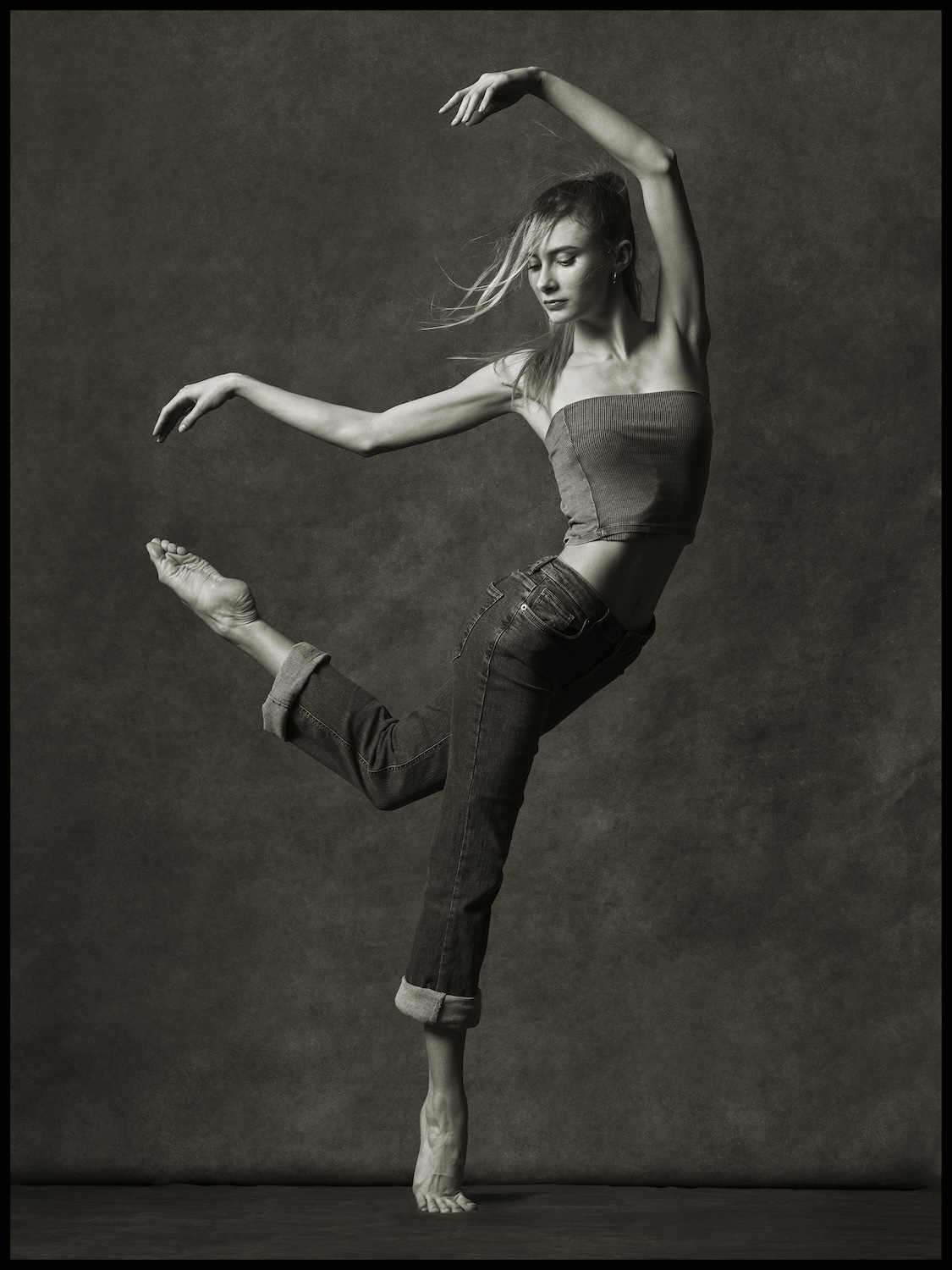
Roma Codex — Behind the Frame
Albert Watson photographs Bianca in a pose whose construction appears to echo the iconography of Shiva Nataraja, the "Lord of the Dance." With her right arm raised, her left leg extended, and her supporting foot firmly grounded, her body seems suspended between balance and movement.
This reference goes beyond a simple visual quotation. Like Shiva, the dancer does not merely occupy space—she recreates it. Each movement becomes an interpretation of the world, where the body, gesture, and individual expression give rise to a new reality. Art does not simply reproduce the real; it gives it form.
Her hair, carried by the movement, recalls Shiva's flowing locks receiving the celestial waters of the Ganga. It suggests that the movement comes from elsewhere, as though the dance established a link between the real and Heaven. Artistic creation then appears as a form of mediation between these two realms.
Her extended leg, however, introduces an important nuance. Whereas Shiva subdues the demon of ignorance beneath his foot, the dancer seems only to have just found her footing. The image captures a moment of transition, as though she had only just entered this struggle. Still in the process of learning, she has not yet fully overcome ignorance; she still has a path to follow before she can truly free herself from gravity.
Finally, her left hand, directed toward the earth, may be understood as a gesture addressed to the viewer. Dance becomes a shared language. It expresses not only technical mastery, but a way of inhabiting the world and offering a personal vision of reality.
The portrait therefore depicts more than a dancer. It presents an artist in the making, whose body gradually becomes the place where creation, transmission, and the dialogue between the real and Heaven converge.
Bianca, Ballet Student
Making of
🔴 The Act of Becoming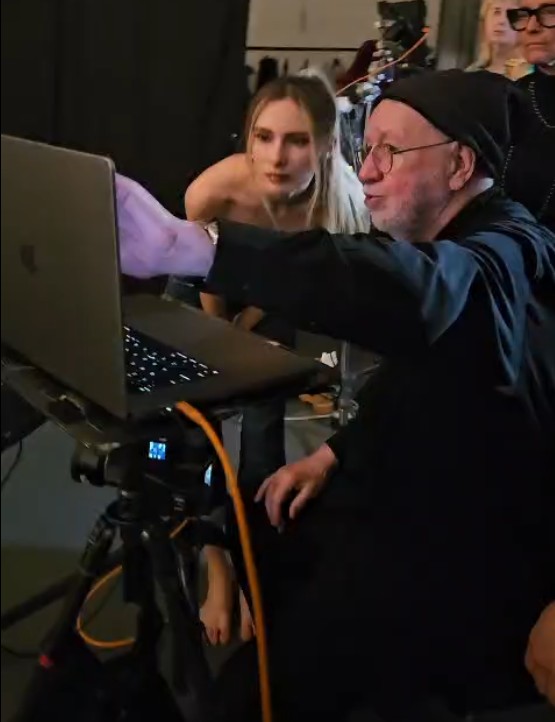
Roma Codex — Behind the Frame
This video offers another glimpse behind the scenes of Roma Codex. It follows Albert Watson working with dancer Bianca, directing the session and gradually shaping the image. Observing his creative process provides a deeper understanding of his staging, the precision of each pose, and the attention given to every detail—all of which enrich the analyses presented on this page.
Pierfrancesco Favino
Actor,
Ristorante Atelier Canova Tadolini
Albert Watson
🟡 LINEAGE / TRANSMISSION / DIVINE HERITAGE 🔴 The Act of Becoming
Roma Codex — Behind the Frame
Albert Watson photographs Pierfrancesco Favino in a posture of remarkable stability. Seated before a glass of white wine, his body is completely at rest. His right hand supports his face, while his index finger rests gently against his lips. His left hand lightly holds the stem of the glass, and his left leg crosses over the right. Nothing seems capable of disturbing this silent equilibrium.
The composition is built upon an almost symmetrical organisation of the body. The two hands mirror one another, occupying opposite yet complementary positions. The crossed legs extend this geometric construction, giving the portrait a sense of carefully controlled harmony. This architecture of gesture recalls certain representations of Shiva Nataraja, whose limbs organise the cosmic movement of creation.
Yet Albert Watson offers its exact counterpart. Whereas Shiva embodies an eternal dance through which creation, destruction, and renewal become one continuous movement, Favino remains perfectly still. The glass does not tremble, his gaze remains fixed, and every gesture is deprived of action. The structure of movement is still present, but movement itself has been suspended. The dance becomes stillness. The destruction that, in Shiva's mythology, always prepares the birth of a new world no longer leads to creation. The creative process itself appears to have been interrupted.
This stillness is reinforced by the gesture of the right hand. The index finger resting against the lips recalls the figure of Harpocrates, inherited from the child Horus in the Greco-Egyptian tradition. Within the context of Roma Codex, this gesture resonates with The Aeon, Aleister Crowley's Thoth Tarot card, in which Horus embodies the advent of a new age. Yet that promise of renewal also appears suspended. As with Shiva, the transformative process never reaches completion. The rebirth announced by Horus fails to occur. The photograph therefore suggests a form of symbolic usurpation: the attributes of the creator are present, yet creative power itself remains absent. Silence no longer precedes transformation; it becomes the sign of creation prevented from taking place.
The setting itself contributes to this symbolic construction. Tadolini preserves several Neoclassical sculptures by Antonio Canova and his pupil Adamo Tadolini. In the background, only the foot of a statue remains visible, The Venetian red walls extend the depth of the space. In the foreground, the scarlet napkin echoes these same tones, and the white tablecloth recalls the whiteness of marble. Colours circulate from one plane to another, yet forms are reversed: the monumental sculpture is reduced to a fragment, while Favino's living body occupies the entire foreground.
The image thus appears divided between two worlds. The upper part belongs to the timeless realm of sculpture, while the lower part remains that of the living human being. Favino stands precisely at their intersection. Between stone and flesh, between Shiva's movement and Horus's silence, between the work of art and the one who contemplates it, he becomes a figure of balance. Yet this balance is not the anticipation of creation. Rather, everything seems held back, as though the creative movement had been interrupted before it could unfold. The portrait no longer presents only an actor, but a figure who appropriates the signs of creation without ever allowing creation itself to come into being. Perhaps it is within this suspension that the photograph's deepest tension resides.
Carlotta Gamba,
Actor in car
Albert Watson
🔵 Identity / Reflection ⚫ THE SHADOW / THE DISSOLUTION
Roma Codex — Behind the Frame
The water running down the glass can be associated with the waters of Ganga, the celestial river descending from Heaven toward the earth. Yet Carlotta Gamba is here inside a car, separated from this water by a double barrier: the glass and the presence of a person in the foreground. This figure, occupying part of the frame without being fully revealed, almost seems to stand between the actress and the waters flowing before her.
Carlotta looks upward, drawn toward something that seems to exist beyond the glass. Her gaze follows the movement of the water, yet her body remains at a distance. She can see it without ever being able to touch it. The glass thus becomes more than a physical separation: it acts as a true barrier, keeping the actress enclosed and preventing contact with what might come from Heaven.
The presence in the foreground reinforces this impression. It seems almost to ensure that this encounter cannot take place, as though an external force were keeping Carlotta away from the water. She is therefore positioned between two worlds: enclosed within the car, she contemplates an external reality that nevertheless seems somehow intended for her.
This gives the movement of the water another significance. In the story of Ganga, the celestial waters must reach the earth in order to purify it. Here, that process appears to be interrupted. The water is present and visible, yet its passage is prevented. Carlotta can only contemplate it through a surface that already transforms her image.
The photograph thus becomes an image of an interrupted possibility. Something comes from Heaven, something might be received, yet an intermediary stands in the way. The actress remains suspended between two worlds, fascinated by what lies beyond the glass, unable to come into contact with it. The car becomes a kind of enclosed space, while the water surrounding her seems to carry the promise of a passage that cannot yet be completed.
Nymphs finding the
Head of Orpheus, 1900
John William Waterhouse
⚫The Shadow / The DissolutionRoma Codex — Points of Entry
The Myth of Orpheus
John William Waterhouse depicts a moment that takes place after the poet’s death. Two nymphs are seated at the edge of a stream, surrounded by a dense, dark forest. On the left, one of the young women, dressed in a long blue gown, leans towards the water; on the right, a second nymph, dressed in shades of pink and mauve, holds a golden vessel against her body. Both direct their attention towards the surface of the pool, where Orpheus’s head appears at the bottom of the composition.
Orpheus is a musician and poet whose singing possesses extraordinary power. His music can move human beings, soothe animals, and even touch the powers of the Underworld. He marries Eurydice, but she dies soon afterward, bitten by a snake while trying to escape from a man who is pursuing her. Inconsolable, Orpheus refuses to accept her disappearance. He descends into the Underworld to find her. His music moves Hades and Persephone, who agree to return Eurydice to him on one condition: he must walk ahead of her without ever turning around to look at her until they have left the realm of the dead.
Orpheus then begins his ascent toward the light, with Eurydice following behind him. But just before reaching the world of the living, overcome by doubt, he turns around. Eurydice immediately disappears, this time forever. Orpheus has definitively lost the woman he descended into the Underworld to retrieve. The suicide attempt fails. He comes back to life, remains inconsolable and continues to sing of his sorrow. His existence now seems entirely absorbed by Eurydice. His fate eventually brings him into contact with the Maenads, the women who accompany Dionysus. Within their Dionysian world, the boundaries between the individual, the group, the human, and the animal become porous. The Maenads eventually kill Orpheus and tear his body apart. His head and lyre are then thrown into the river, yet his head continues to sing before being recovered.
Orpheus and the Nigredo
This trajectory can then be brought into relation with the process of the nigredo. Orpheus enters a phase of dissolution after his second loss of Eurydice. In this reading, his fault is not that he loved Eurydice, but that he ultimately made her the meaning of his life. Once he loses her definitively, he can no longer define himself independently of her.
The Dionysian festival then becomes the symbolic setting for this dissolution. The individual loses his boundaries and merges into a collective experience in which identities become blurred. For Orpheus, this inner dissolution eventually finds its physical equivalent in the tearing apart of his body. What had already begun to dissolve within him is now destroyed in matter. Orpheus therefore gradually loses a part of himself, including what made him an artist. He remains a musician, but his art is no longer carried by a life that gives it meaning. His mistake may have been to forget that his musical gift was itself a vocation, independent of his role as Eurydice's husband.
Waterhouse ne peint pas le moment de la mort, mais le moment où quelque chose reste après elle. Son chant a changé de nature ; il est devenu le ruissellement de l'eau. Les deux nymphes paraissent troublées par cette présence qu'elles ne peuvent saisir. Elles se penchent vers le ruissellement comem si quelque chose les appelait depuis la surface. Orphée devient presque un être de la nature, à l'image des nymphes elles-mêmes.
Son chant aurait ainsi changé de forme. Il ne se fait plus entendre comme une musique, mais comme le mouvement de l’eau. Orphée semble avoir quitté le monde humain pour rejoindre celui qu’il avait toujours su charmer.
David Bowie
Albert Watson
⚫The Shadow / The Dissolution
Roma Codex — Points of Entry
Albert Watson depicts David Bowie’s severed head enclosed within a wooden cage, sealed by a metal grille. The staging immediately evokes imprisonment, sacrifice, and symbolic death. Separated from the body, the head is stripped of any possibility of action. Its closed eyes reinforce a sense of silent inwardness, while the cage recalls both a reliquary and a kennel, reducing the human being to an almost animal condition.
The image can be related to the concept of nigredo, the first stage of spiritual alchemy, in which the individual undergoes the dissolution of the ego. Traditionally, this phase is understood as a necessary passage toward rebirth. Here, however, nothing suggests the possibility of transformation. The process appears to have reached its conclusion without giving rise to a new existence.
The cage thus becomes the symbol of a permanent confinement. Deprived of his spiritual dimension, man remains imprisoned within matter. The initiatory promise collapses: the dissolution of the ego does not lead to higher consciousness, but to an existence reduced to instinct alone. The human being becomes a human animal, cut off from the spiritual dimension that once gave meaning to his existence.
This reading finds a particular resonance in David Bowie's artistic journey. During the 1970s, his work drew extensively on references to esotericism, occultism, and initiatory traditions. The photograph seems to extend that reflection by portraying not the fulfillment of a spiritual quest, but its reversal. Where initiation promises elevation, only an imprisoned head remains, severed from any connection to Heaven.
Unlike the head of Orpheus in John William Waterhouse's painting, whose song continues to resonate beyond the poet's death, David Bowie's head remains silent. Work, song, art does not disappear, but it is no longer presented as a force capable of opening a path toward the spiritual. Instead, it bears witness to a human condition enclosed within its own limits.
Olimpia Pagni
Club, Muccassassina
Albert Watson
⚫ THE SHADOW / THE DISSOLUTION
Roma Codex — Behind the Frame
Albert Watson photographs opera singer Olimpia Pagni during Muccassassina, a celebrated Roman night where identities, appearances, and social codes are deliberately blurred. In this nocturnal atmosphere, her neck almost completely disappears into darkness, creating the impression that her head is gradually becoming detached from her body. Her almost-closed eyes reinforce this sense of suspension, as though she were already standing at the threshold between two worlds.
This staging can be associated with the myth of Orpheus. Like the Thracian poet, the essence of Olimpia Pagni's profession seems to survive through her head. The image suggests this idea by dissolving her neck into this mass of darkness.
The choice of Muccassassina directly reinforces this reference. After the definitive loss of Eurydice, Orpheus remains inconsolable and seeks to drown his grief in a life turned toward debauchery and Dionysian revelry. The Maenads, who belong to the procession of Dionysus, eventually kill him and tear his body apart. The celebration thus becomes a symbolic prelude to his destruction.
Muccassassina then appears as the setting for an unfinished metamorphosis. The separation of head and body does not reveal a spiritual accomplishment, but rather a rupture. Far from leading toward a higher consciousness, it deprives the human being of his spiritual vocation and returns him to an existence governed by instinct, that of a human animal.
The photograph thus extends the reflection initiated through the myth of Orpheus. Art remains, but it does not allow the human condition to be transcended. What survives is not a victory over death, but the fragile testimony of what made the individual unique.
David Bowie
Albert Watson
⚫ THE SHADOW / THE DISSOLUTION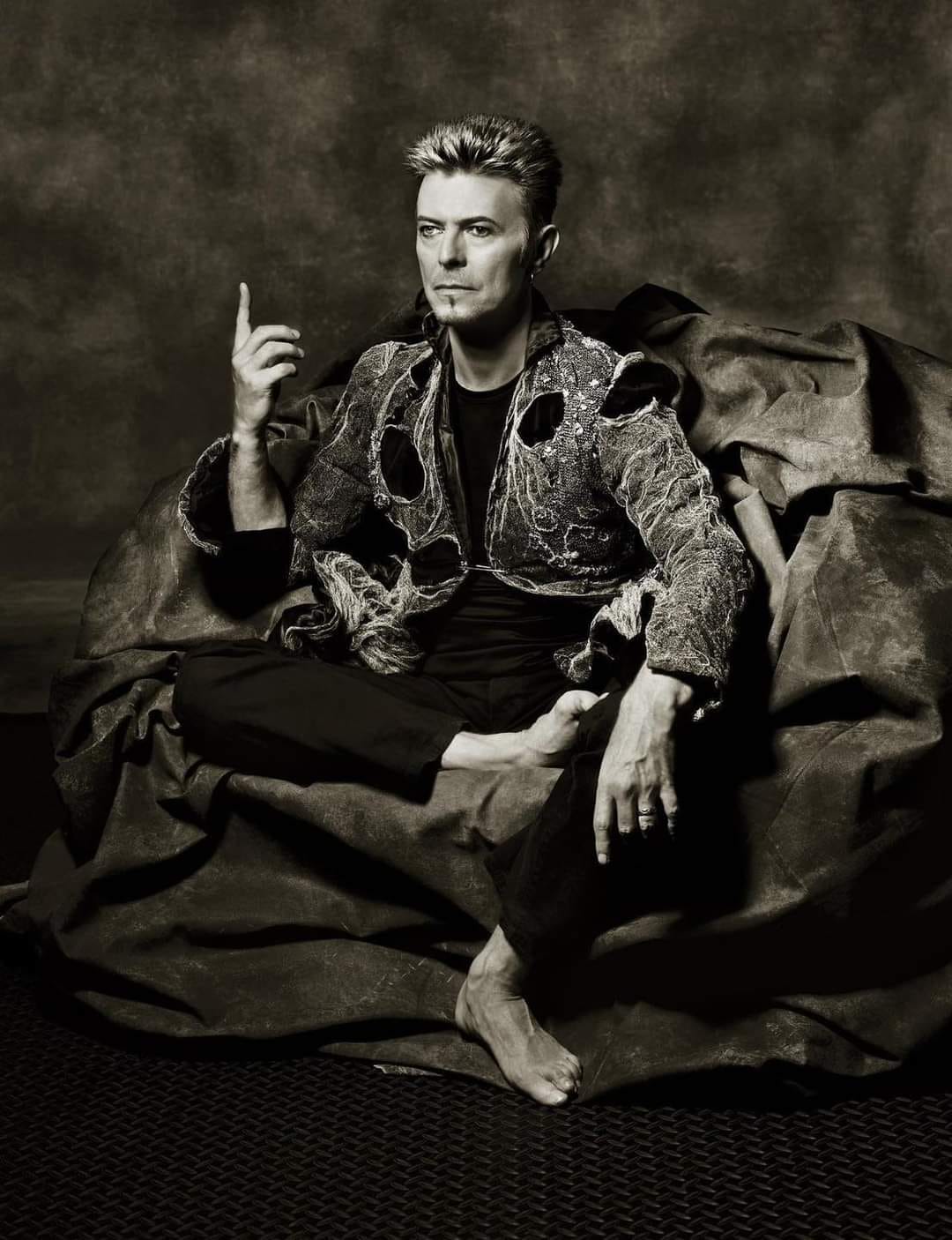
Roma Codex - Points of entry
One hand pointing to the sky, the other to the ground:
a dual iconography that recalls Baphomet and the principle of “as above, so below”.
A construction that resonates with Bowie’s interest in esoteric systems associated with Aleister Crowley.
Museum and Crypt of the Capuchin,
Friars, Bones, Skeleton
Albert Watson
⚫ THE SHADOW / THE DISSOLUTION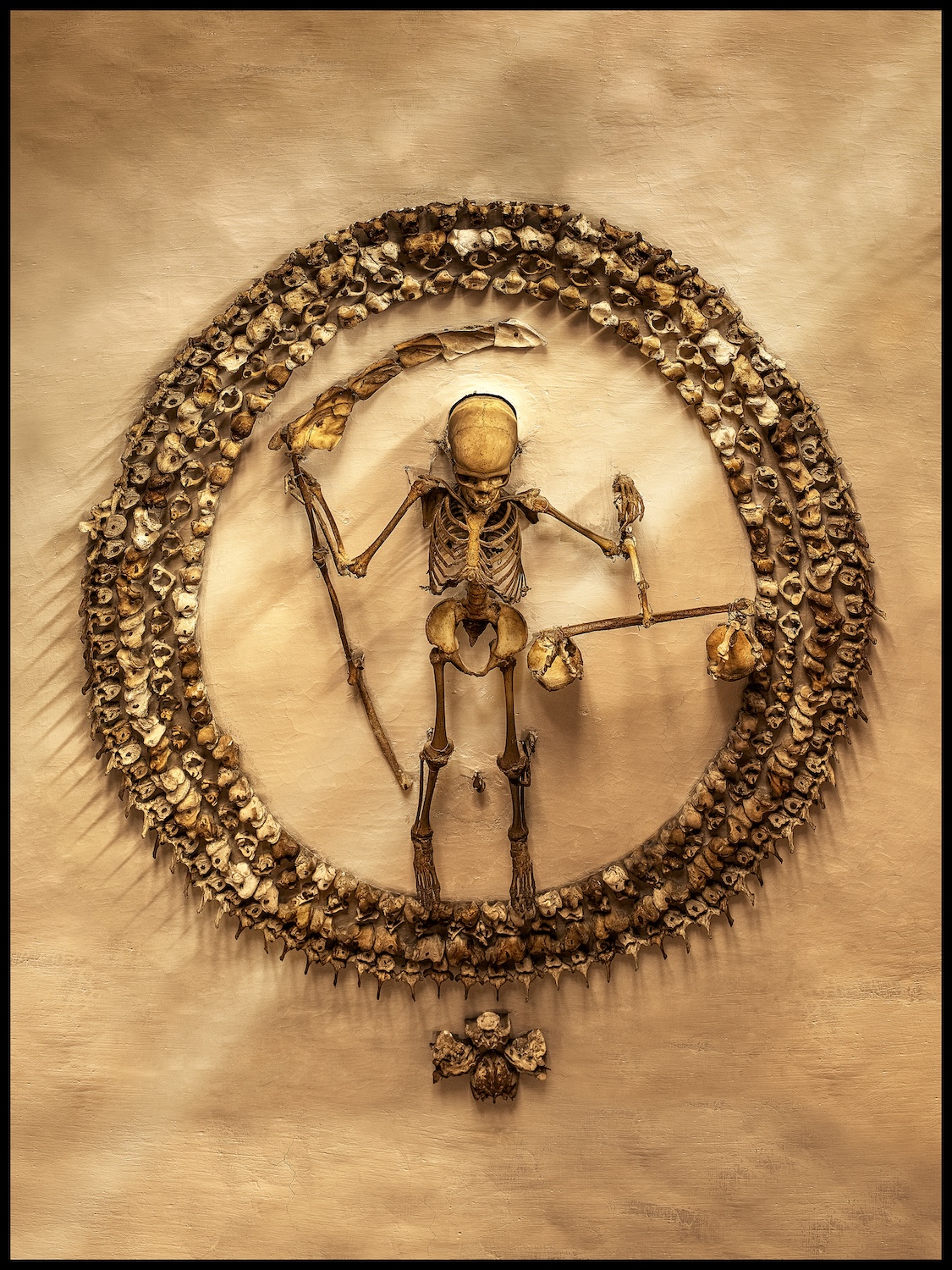
Roma Codex — Behind the Frame
In the Crypt of the Capuchin Friars, Albert Watson captures a skeleton suspended from the ceiling of one of the rooms, integrated into a composition of bones conceived as a visual device.
In 1631, following the construction of the church, Cardinal Antonio Marcello Barberini ordered the transfer of the remains of the Capuchin friars and their “artistic” arrangement.
This gesture took place within the context of the Inquisition — an institution of the Church responsible for preserving religious orthodoxy by identifying and judging doctrinal deviations. The remains of the monks thus become motifs, structure, almost language — an arrangement that sacralises disappearance.
The central figure, holding a scale and a scythe, brings together a composite iconography. The two symbolic figures they traditionally refer to are here replaced by a human figure, embodied by the skeleton of the monk. The scale recalls the attributes of judgment associated with Saint Michael the Archangel, while the scythe evokes Samael, a figure of the angel of death, the very embodiment of chaos, punishment, anger, death ans disorder.
Judgment and death are no longer carried by a celestial figure, but by a human body reduced to a skeletal state — as if the Church, through man, had taken the place of divine judgment and mortality. This macabre staging becomes an ode to death. Through light and a golden background, Albert Watson repositions these figures within a celestial space, echoing the codes of religious iconography. The rays of light evoke divine illumination passing through stained glass windows, reinforcing this spiritual dimension — while revealing it as a constructed one.
As written in the crypt, a phrase also found in Masaccio’s Trinity (1425–1428),
where it appears above Adam’s tomb in the form of a first-person singular inscription:
“Io fui quel che voi siete e quel ch’io sono voi anco sarete”
(“I was what you are, and what I am, you will also be.”).
Cuirassiers Regiment,
Quirinal Palace,
Horses, Uniforms
Albert Watson
⚫ THE SHADOW / THE DISSOLUTION
Roma Codex — Behind the Frame
Albert Watson photographs a succession of cuirassiers advancing on horseback. The repetition of their silhouettes creates an effect reminiscent of chronophotography: each rider seems to replace the one before him, as though a single figure were repeating itself through time.
The uniforms, helmets, and horses construct an image in which individual distinctions become almost imperceptible. What remains is no longer the person, but the enduring permanence of the role.
This composition extends the symbolism of the nigredo. Traditionally, the dissolution of the ego marks the beginning of a process leading to spiritual rebirth. Here, however, that rebirth never takes place. The erasure of the individual becomes the very condition of the institution's continuity.
Each rider succeeds the previous one without altering the established order. Continuity depends upon this transmission, in which individuals pass away while the function endures. The image suggests that the institution's permanence rests precisely on this continual replacement of individuals, each occupying only briefly a position destined to be taken up by another.
This interpretation stands in tension with initiatory traditions. Whereas the nigredo heralds an inner transformation and the emergence of a renewed consciousness, Albert Watson appears to reveal its inverse. The dissolution of the ego does not lead to spiritual rebirth but to a form of dispossession. The riders do not become freer or more enlightened beings; instead, they disappear behind the function they embody, reduced to ensuring the continuity of an order that transcends them.
Cuirassiers Regiment
Quirinal Palace, horse
Albert Watson
⚫ THE SHADOW / THE DISSOLUTION
Roma Codex — Behind the Frame
Albert Watson photographs a Corazzieri cavalryman as he raises his sword and calls out a command. His helmet almost completely conceals his gaze, as though his identity were gradually disappearing behind the role he embodies.
This concealment may be related to the nigredo, the first stage of spiritual alchemy. Within initiatory traditions, this "black work" marks the dissolution of the ego before an inner rebirth. Darkness is not an end in itself, but the beginning of transformation.
Yet the photograph appears to suspend this process. The gaze remains hidden beneath the helmet, while the cavalryman's voice merges with that of the institution he represents. Nothing suggests spiritual elevation. The dissolution of the ego does not lead to renewed consciousness; instead, it results in the gradual disappearance of the individual behind his function.
The portrait therefore questions the boundary between commitment and dispossession. At what point does serving a role cease to express a personal will and begin to absorb the person who performs it? Where alchemy promises rebirth, Albert Watson seems to present an unfinished transformation, leaving the man confined within the function he embodies.
St Peters Square,
Christmas Tree, Seagulls, Birds
Albert Watson
🟡 LINEAGE / TRANSMISSION / DIVINE HERITAGE 🔴 The Act of Becoming ⚫ The Shadow / The Dissolution
Roma Codex — Behind the Frame
In the foreground, several seagulls occupy the space of the square, some standing still, others in motion, as if they had temporarily become its inhabitants. Behind them unfolds the architecture of the Vatican, a monument deeply charged with history and symbolism, while an immense Christmas tree rises in front of the façade, surrounded by security barriers that define the area reserved for visitors.
This tree inevitably evokes the one at Rockefeller Center in New York. Yet the image does not appear to offer a simple critique of American influence. Rather, it raises a deeper question: that of the displacement and replacement of symbols.
Throughout Roma Codex, Albert Watson often explores themes of transmission, heritage, and continuity. Here, an element drawn from a contemporary, globalized culture takes its place at the heart of a city whose identity has been shaped by centuries of history. The contrast does not lie solely in an opposition between Rome and America, but in the way symbols travel, transform, and take possession of new territories.
The seagulls then become an essential element in the reading of the image. They occupy a space momentarily deserted by human presence. Their presence gives the impression that an urban environment, usually controlled and carefully organized, now belongs to them.
This situation recalls Venice, where some hotels and monuments call upon falconers to drive away seagulls that have become increasingly intrusive within the city. The falcon is not merely a method of regulation: it carries a symbolic dimension, that of a guardian whose role is to preserve balance.
This reference echoes the figure of Horus, the falcon-headed god of ancient Egypt, protector of the pharaoh and guardian of cosmic order. While Horus watches over the harmony of the kingdom, the seagulls appear here as temporary occupants of a space from which the former guardians seem to have disappeared. The absence of the falcon becomes as meaningful as the presence of the birds themselves. Nothing appears to restore the usual order. Between the monumental Christmas tree, a symbol of an international imagination, the Vatican, a reminder of an ancient history, and this nature that temporarily reclaims possession of the space, Rome appears as a city in transition.
Albert Watson appears to stage a silent displacement of symbols: some fade away, others emerge, and the city becomes the place where these different layers of time coexist — sometimes harmoniously, sometimes in a fragile state of tension.